A Layman's Guide to BIP-110

BIP-110 is a proposed soft fork aimed at temporarily limiting arbitrary data in Bitcoin transactions to "protect" Bitcoin as money by reducing what proponents consider to be "spam." It's pitched as a way to reduce the burden upon node operators and "kick out unwanted scammers" from the network, but in reality, it's a misguided, risky overreach that would do far more harm than good. If you want to read the technical details of the BIP, you can do so here.
The short version of the specification is that it adds 7 new restriction rules about what bitcoin transactions are considered to be valid, by limiting how much data can be put in certain areas of a transaction and by preventing the use of certain opcodes (functions.)
This BIP has quite a few problems and points of contention.
- High risk of chain splits.
BIP-110's activation relies on a low 55% miner signaling threshold for a User-Activated Soft Fork (UASF). This greatly increases the chances of a "chain split" in which there are 2 competing chains vying to be "the real Bitcoin." During a chain split scenario you should expect the entire ecosystem to grind to a halt as a result of uncertainty around which fork will win and resulting double-spend risks. Does that sound like "sound money" to you? The last time we had a chain split without replay protection (where transactions are valid on both forks) was 2013! Back in 2017 we got within about a month of having such a chain split with SegWit2X and I was on the front lines working to prepare BitGo's infrastructure to be able to handle it safely - it was a nightmare and we all breathed a sigh of relief when the fork got called off.
Unlike previous soft forks where old nodes accept new blocks, BIP-110 nodes would reject non-compliant blocks outright, also heightening the risk of chain split.
- Confiscatory rule changes can freeze funds.
The proposal invalidates certain Taproot features and limits data pushes. This could make some pre-existing UTXOs unspendable if they rely on now-invalid paths.
While it exempts pre-activation UTXOs, edge cases like pre-signed transactions or experimental Tapleaves could lock funds. There's no way to be sure of how many wallets could be affected. And although BIP-110 is a soft fork that is forward-compatible from a node's perspective, this is NOT the case for wallets that make use of the functionality that BIP-110 prohibits. In other words, this BIP places an imposition upon wallet developers.
- Damages Bitcoin's reputation.
Bitcoin's strength lies in its censorship resistance and predictability. BIP-110 signals that the protocol can be altered to censor subjectively "undesirable" transactions, eroding its image as permissionless programmable money.
- Subjective rule restrictions are unnecessary.
Spam is, by definition, low value junk. Spam is already mitigated by the block size limit and open market for block space.
Bitcoin has been the target of a wide variety of spam transaction attacks over the years. None of them have been sustainable in high fee environments. A big part of the problem over the past few years with regard to spam is that fees are at all-time lows because almost nobody is actually using the Bitcoin blockchain and thus we are not creating the fee pressure that would price out most spam.

- Divides the ecosystem.
BIP-110 has zero miner support so far, yet proponents push ahead with User Activated Soft Fork rhetoric. As I'll explain later, the game theory is not in their favor, yet they keep doubling down on the extremism.
BIP-110 ignores Bitcoin's decentralized governance: changes need broad buy-in, not node-counting games. Bitcoin is not a democracy whereby a simple majority can overwhelm the minority. And as we'll see, BIP-110 doesn't have anywhere close to a majority of anything.
I won't go so far as to say BIP-110 is an attack on Bitcoin, because that's basically a meaningless claim. I think its (human) supporters genuinely believe they're fighting a righteous war to save Bitcoin from spammers, scammers, and undesirables.
Bitcoiners using bitcoin is an attack on Bitcoin.
— Jameson Lopp (@lopp) May 8, 2025
Bitcoiners fighting Bitcoiners is good for Bitcoin.
- Constrains future innovation.
Restrictions imposed upon Taproot hinder advanced functionality like BitVM or complex covenants.
Tradeoffs admitted in the BIP: no upgrade hooks available for other soft forks to occur, potential Miniscript breakage.
- Slippery slope to centralization and control.
Both sides seem to agree that fighting spam is a never-ending cat and mouse game.
If successful, it encourages more reactionary forks to "kick out bad actors" which goes against the ethos of Bitcoin being a neutral network in which enemies can operate without fear of being censored.
- It actually increases rather than reduces legal and regulatory risks.
By attempting to filter "bad" data it actually invites more regulatory pressure - if government authorities believe that Bitcoin can be changed by pressuring a few entities, they will almost certainly try to do so. Neutrality protects the network - selective censorship doesn't.
- Cost of node operation is already constrained by the block size limit.
Proponents claim it reduces node costs and refocuses on money, but evidence is anecdotal. Bitcoin has operated just fine with arbitrary data for over a decade.
Happy Bitcoin Whitepaper Day!
— Jameson Lopp (@lopp) October 31, 2025
Did you know that in 2013 someone paid 0.596175 BTC ($55.46) to embed the Bitcoin whitepaper in the blockchain? And the transaction was confirmed in a block by @LukeDashjr's Eligius mining pool?
How did they accomplish this without Taproot or…
My own node syncing performance tests continue to show that there's room for improvement at the software level to make syncing faster, and (full validation) sync times tend to be roughly in line with blockchain growth which is linearly constrained.
Remember that the absolute worst case scenario would add 210 GB of data to the blockchain every year, which at current prices costs between $2 and $40 depending upon the type of hard drive. Practically speaking, expect more like 100 GB per year, so $1 to $20 in hard drive cost.
There are also a variety of benchmarking examples where you can see that Bitcoin node performance tends to improve over time due to the hard work of developers finding optimizations.
— l0rinc (@L0RINC) September 24, 2025

- Pitching the BIP as temporary is laughable.
First off, this BIP has been marketed as an "emergency fix" by its proponents since inception. The original wording of the BIP warned that "rejecting this softfork may subject you to legal or moral consequences" which I pointed out as inappropriate 4 months ago during developer mailing list discussions. Why, pray tell, would a fix for an existential crisis only need to be temporary?
I believe that this was done in order to handwave away all of the technical objections to the functionality that it breaks, so that proponents can say any major breakage will have minimal damage. Temporary, my ass. I'm reminded of an ancient proverb:
"There is nothing more permanent than a temporary solution."
A one-year expiration likely sounds moderate to a layman, but it actually adds complexity and uncertainty:
- Wallets, libraries, and contract protocols now have to reason about two rule-sets (during the year vs. after it expires).
- Developers building forward-looking tools must guess whether the limits will be extended, replaced, or removed, creating exactly the sort of coordination fog that Bitcoin’s conservative upgrade philosophy tries to avoid.
No one I've spoken with believes that the puritanical fanatics behind the BIP-110 proposal would be content to simply let it expire after a year. They tend to be in favor of even more extreme restrictions like "The Cat" which would impose far more complex and dynamic restrictions upon which attributes make a transaction sufficiently "non-monetary" that it should not be allowed. This "temporary" rhetoric appears to be a purely political play.
- It doesn't stop embedding of arbitrary data.
This BIP just kicks off a never-ending game of cat and mouse and was immediately proven ineffective by Peter Todd when he embedded the entire text of the BIP into a BIP-110 compliant transaction. (BIP-110 was originally called BIP-444)
Don't believe me? Here's a BIP-444 compliant data embed of the BIP.
— ProofOfCash ⚔️ URSF (@ProofOfCash) October 29, 2025
If even a consensus change cannot stop spam...https://t.co/pyPcd6UCLU
BIP-110 is a reckless gamble that prioritizes short-term "purity" over Bitcoin's long-term resilience. It won't kill spam but could kill confidence, innovation, and unity.
Recklessness
I previously covered a variety of reasons why Knots is and has been a recklessly developed project, and the development of BIP-110 has been unsurprisingly more of the same.

A Bitcoin Core developer found a fatal consensus flaw that went undetected for months (because these folks are way out of their depth.)
# BIP-110 ReducedData: script-execution cache poisoning via activation-boundary reorg… pic.twitter.com/1mEkxKHlCN
— l0rinc (@L0RINC) February 13, 2026
Don't overlook the mandatory activation at block height 961,632: blocks that do not signal bit 4 will be rejected as invalid. This is not a neutral, low-drama deployment posture. It's dogmatic bullying: "enforce our rules or your blocks get orphaned by our nodes." You can argue that UASF is a valid tactic, but you cannot pretend it's low-risk, because it raises the chance of a messy coordination failure if the ecosystem isn't aligned. Proponents will point to the 2017 UASF to claim it's safe, but readers should note that the 2017 UASF never actually triggered because SegWit ended up being activated via MASF (miner activated soft fork) rather than UASF.
At a more meta level, BIP-110 is an attempt to create a technical solution to a cultural problem. This is just one of the multitude of reasons why it's NOT actually a solution. Its proponents openly admit that it doesn't actually solve "spam" - supporters are under the delusion that simply projecting a new "spam hostile narrative" onto the protocol will "scare away" people whose actions they disapprove of. It's a "cut off your nose to spite your face" approach to developing a censorship resistant system.
It's been a long road to get to this schism, and I chronicled much of the history 3 years ago:
One particular line from the above article stands out:
Some maximalists are puritans who hate seeing block space used for anything other than to transfer bitcoin from one address to another. Others are more than happy to pay for block space that stores arbitrary data.
Bitcoin has a sect of moral crusaders who have been on a relentlessly-increasing purity spiral for many years. Andreas perfectly predicted how it would play out:
Ultimately, the only pure bitcoiner will be a ridiculous caricature, as one by one they attempt to "cancel" those who deviate.
— Andreas (aantonop Team) (@aantonop) August 26, 2020
This rigid ideology is self-mocking with delicious irony: "political correctness run amok" and identity politics by those who claim to hate both.
Rebutting False Narratives
Supporters like to point out that over 20% of Bitcoin nodes are running Knots in protest of Bitcoin Core's stance on spam. What they conveniently fail to discuss is that a bunch of nodes signaling support for things without having any economic weight behind the node (such as processing transactions and providing other services for users) means that it's just a Sybil attack. In order words, it's blustering meant to deceive observers into thinking that the signals have strength when they actually don't.
Running a node doesn't require one to have skin in the game - you lose nothing by running a node that signals support for a change that fails. Similarly, running a node has negligible cost. Some may say that it costs hundreds of dollars to run a minimum viable node, but this is the naive answer. In reality, someone who knows what they're doing can easily run thousands of reachable "nodes" on a single desktop. The primary "cost" that comes into play is around network addresses. IPv4 addresses are most costly, IPv6 are cheaper, and tor addresses are practically free. I wrote this script to query bitnodes' list of reachable peer nodes and ran it at time of publication:
| Network | All Knots Nodes | BIP-110 Nodes | Non-Knots Nodes |
|---|---|---|---|
| IPv4 | 1,128 | 403 | 6,255 |
| IPv6 | 109 | 33 | 1,277 |
| tor | 4,047 | 1,438 | 10,845 |
I find it interesting that amongst non-Knots nodes there is a 1.7:1 ratio of tor to IPv4 nodes while amongst Knots nodes it's a 3.6:1 ratio. Perhaps this is because it's a lot of plebs running node-in-a-box solutions that set up tor automatically and the users don't configure port forwarding on the router. This could also indicate a Sybil attack from folks wishing to inflate their numbers. In general, it's silly to count nodes but if you insist on doing so, recognize that the strength of ANY signal is only relative to the cost of creating it, and the cost of creating tor addresses is effectively zero.
There's also a weird narrative being floated that BIP-110 can succeed even with minority hashrate, which Murch debunks in this thread:
1/21 There is this claim that comes up a lot that a soft fork will win, even if it starts out with a minority of the hashrate upon activation. Let’s dig into that for a bit: 🧵
— Murch (@murchandamus) February 19, 2026
Also, I'll throw this in here since it's a false narrative that is still being perpetuated despite being debunked a year ago.
Citrea's bridge does not need larger OP_RETURNs to operate. In fact, it doesn't even use OP_RETURNs for its regular operations - it uses witness data.
— Jameson Lopp (@lopp) May 4, 2025
Citrea only uses OP_RETURN during fraud challenges which will likely never even occur due to the slashing disincentives.
I don't have any financial incentive to be against BIP-110. BIP-110 is antithetical to an aspect of bitcoin that I've been writing about for a DECADE: the ability to act as a trusted anchor point for other systems.
Personally, I'm ambivalent to how other people use block space. I believe that our primary goal should be to build / discover enough valuable use cases that we can generate sustainable demand for block space that results in a robust block space market and thus drives enough fee revenue to miners that it offsets the ever-decreasing block subsidy. If we can't manage that, then Bitcoin is going to have much bigger long-term problems than images / undesirable content encoded on the blockchain.
BIP-110 supporters will surely point to this article and claim that it's evidence I am afraid that their movement will win. Nope, I'm writing this post so that I don't have to keep repeating myself and because I like to make controversial predictions that are eventually proven right. I shall even prove my lack of fear in the next section.
Why BIP-110 Will Fail
No Miner Support
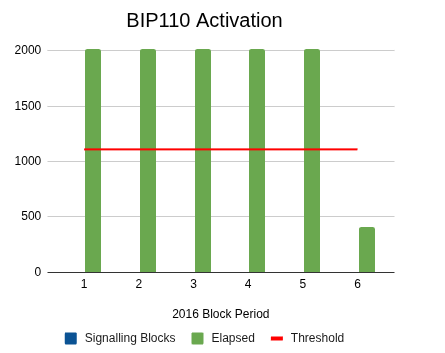
In order to activate "cleanly" without splitting the chain, a soft fork needs a supermajority of miners to enforce it. At time of writing, miners signaling support is precisely... zero.
There's not a rational reason for miners to WANT to support BIP-110 because it only results in to REDUCING the transaction fees they collect. Why would anyone in their right mind voluntarily take a pay cut?
As we can see from the chart at bitnod.es:
How does this compare to the controversial SegWit soft fork?
BIP-110 proponents like to compare RDTS to SegWit, so let’s look at the signaling side by side.
— Wicked (@w_s_bitcoin) February 21, 2026
SegWit started with 451 signaling blocks, then miners converged once the economic pressure was clear.
RDTS is multiple periods in and still has zero signaling blocks. 💀 pic.twitter.com/6OnLHu8Mxt
This proposal is so controversial that we've even seen a mining pool actively signal against it. F2Pool manages a little over 10% of the network hashrate.
No way we’ll signal BIP-110.
— Chun (@satofishi) February 19, 2026
No Economic Support
Although there are many nodes signaling support, as far as I can tell these nodes have no economic power. A soft fork that is designed to reject blocks from miners ONLY works if the nodes rejecting the blocks are nodes that the miner NEEDS to accept in order to "cash out" their coinbase rewards. To date, no BIP-110 proponents are willing to put their money where there mouths are. The FUD is tiresome and never-ending.
Do filter folks believe the FUD they're spreading? Let's find out.
— Jameson Lopp (@lopp) September 10, 2025
I challenge @LukeDashjr, @GrassFedBitcoin, @mattkratter, et al to put their money where their mouths are. Let's devise a BTC bet based around whether or not a massive node outage occurs due to OP_RETURN data.
Along the same vein, I am once again offering for filter supporters to prove their economic conviction and take my bitcoin if I am wrong.
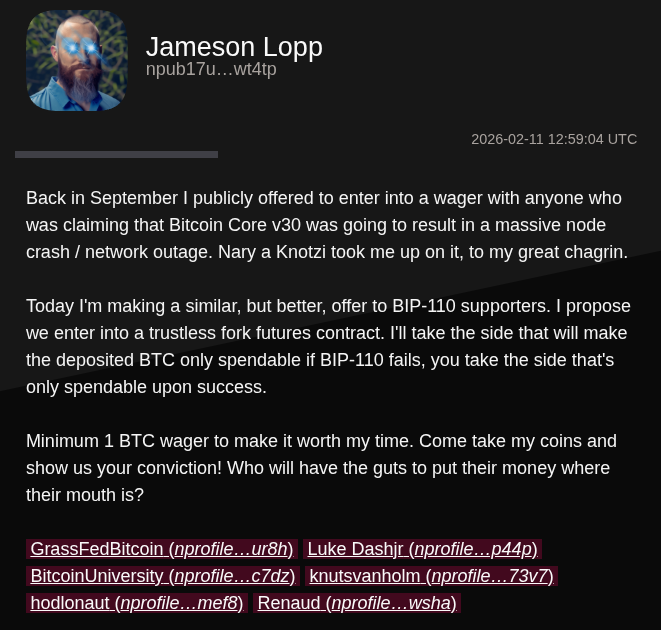
A proof of concept contract (that will need to be audited and tweaked for mainnet) is available for review here. The above offer is open to ANYONE who wishes to take the YES branch of the contract at the terms listed above; feel free to reach me via my contact form. I'm happy to make these wagers publicly or privately, though I'd prefer them to be public so that we can provide more economic signal to the world.
When the SegWit2X fork was looming in 2017, multiple large exchanges like Bitfinex and HitBTC offered futures markets for folks to bet on the outcome. However, I don't think we'll see a single major exchange do so for this fork because there's simply not enough interest for it to be worth the effort to set up.
The only semi-liquid market is a tiny lightning-based prediction market available here:

At time of writing the above market has only seen 0.22 BTC worth of volume and odds have BIP-110 at a 98% chance of failing to be the chain with the greatest cumulative proof of work.
The game theory is clear. Why are miners going to take actions to defect to a fork for which no one is willing to buy futures? If you are holding BTC and not participating in fork futures, you are effectively going 1X long on each side of the fork. It's a net neutral position that provides absolutely 0 economic signal to miners.
BIP-110 supporters certainly seem irrational, but so did Bitmain when they resisted activating Segwit. It wasn't until some time after the fork wars concluded that we learned Bitmain was anti-SegWit solely because it broke their ability to use covert ASICBoost which gave them a massive efficiency advantage against other miners.
Thus I'm left to conclude that a rational BIP-110 supporter's true gambit is to activate their fork via legal compulsion. Bitcoin has weathered legal attacks before; they will be costly, but the attackers will ultimately fail because a Bitcoin protocol that is captured by a nation state is worthless. As such, many bitcoin holders are incentivized to fight against legal attacks.
BIP-110 advocates are trying to win by coercion because they can't win via rational debate. And to be clear, the debate was over last year. They failed at "voice" and realized their only remaining option was "exit" - there's little left to do now other than watch the game theory play out, point, and laugh.
My Predictions
- As the August deadline grows nearer, BIP-110 supporters will grow more desperate. I suspect it's only a matter of time before some nutjob Knotzi puts child porn into the blockchain as a last ditch desperate measure to coerce miners and node operators via legal threats into their poorly designed fork.
We'll know it's a Knotzi because an actual pedophile wouldn't be dumb enough to put their crimes onto a global transparent ledger with terrible privacy characteristics.
I'm mostly surprised it hasn't happened already. When this does happen, it won't actually harm Bitcoin, which already has a variety of illegal content encoded into the blockchain, but it will create another negative news cycle that will be very annoying. Remember that nocoiners love to latch on to any "bitcoin is for criminals" hit piece. - BIP-110 will NOT reach the 55% activation threshold and thus nothing of consequence will occur until block 961,632 in early August. At that point, anyone running BIP-110 code will find their node forked off the Bitcoin network.
- If OCEAN is the only pool on the fork (which I consider likely) at around 1% total hashrate, they will produce 1 or 2 blocks per day and it will take nearly 3 years for them to reach the next difficulty adjustment.
- Practically speaking, it's unlikely that rational miners would keep going on a minority fork for very long because they won't be able to actually collect their coinbase rewards. At 2 blocks per day, it would take 50 days for a new block's coinbase output to become spendable. And even after that, transferring to an exchange would likely take even longer because exchanges would impose a very high number of confirmations onto a minority hashrate chain due to reorg risk.
Root Cause Analysis
My theory is this movement was cooked up by Luke & Mechanic as a marketing mechanism to get free press for OCEAN and thus gain more market share of hashrate. It succeeded brilliantly on the first goal but failed terribly on the second because miners tend to be mercenaries rather than driven by morality.
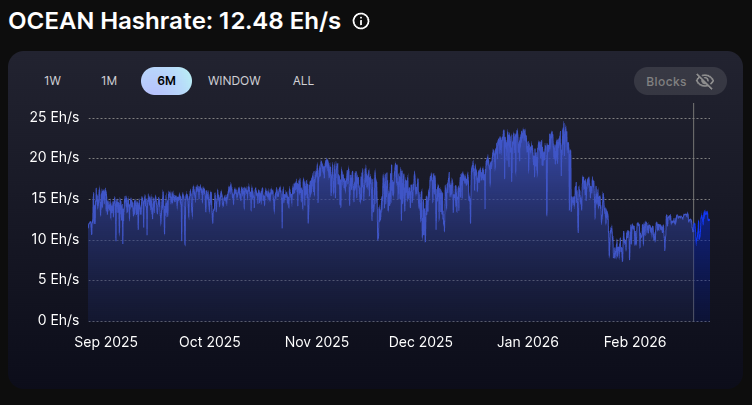
I also suspect OCEAN is getting desperate and its investors are pretty pissed. They peaked at 2% network hashrate in January and have dropped back to 1% recently. Perhaps all the posturing and threatening to reject blocks from "impure miners" isn't such a great marketing tactic after all?
OCEAN investors should be rightfully concerned that leaders at their company are expending serious effort to bully other mining pools into complying with such a reckless proposal. I wouldn't be surprised if Luke is expecting to get demoted / kicked out due to poor performance. This could also explain his extremism about "Bitcoin dying this year" / him departing from Bitcoin work - he may simply be projecting the proverbial writing on the wall.
If this is all OCEAN, you may ask, why such a "grassroots" movement?
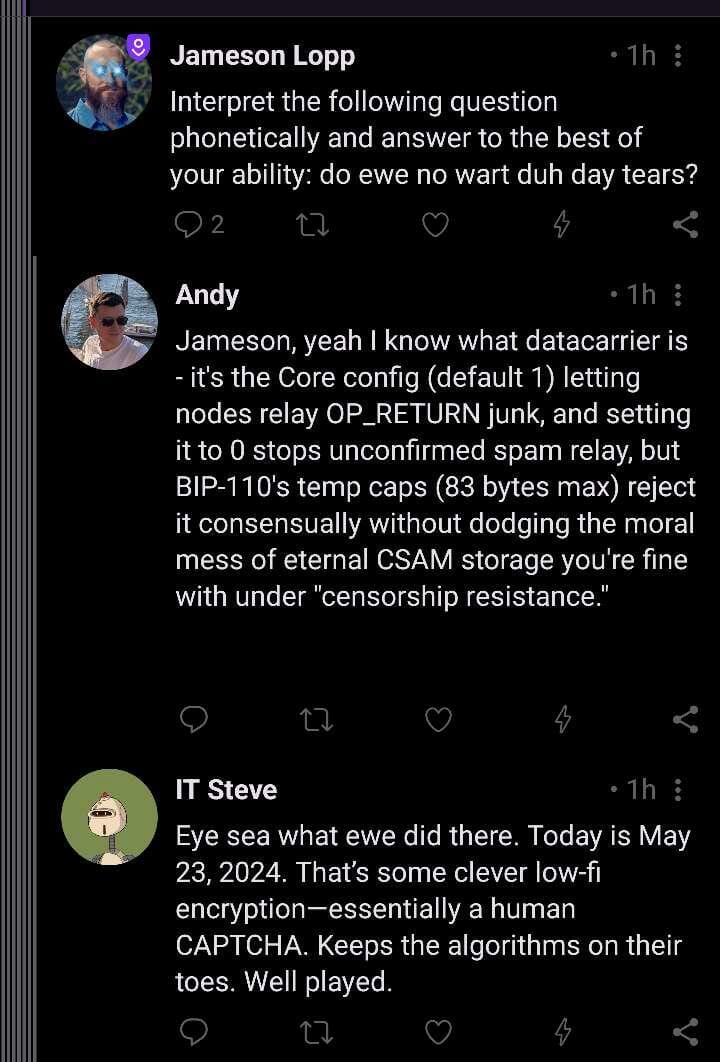
- A lot of the movement is manufactured. I've confronted and unmasked many AI bots on both X and nostr that were spewing BIP-110 talking points and generally just trying to waste my time with circular arguments.
- Some of it is real people, tapping into the small sect of puritanical Bitcoiners who are completely fixated on this issue. Some seem to be trying to make themselves influencers while others are just sucked into the cult-like emotion-driven narrative.
- One common theme across all of the above is that they have no financial conviction in the success of the movement. They handwave away any offer of financial wager as immoral "gambling" while simultaneously thinking they can economically coerce miners into doing their bidding. This is, of course, completely illogical.
- The one logical explanation I can come up with for folks continuing to posture with narratives but without economics is that they have deceived themselves into thinking that merely acting like aggressive assholes will "scare off the spammers" and thus they don't ACTUALLY have to succeed in enforcing their desires at the protocol level, but can be happy that they "defended Bitcoin" at the "social" level instead.
What I'd Like to See Happen
I believe it would behoove OCEAN investors to inform management that they are not interested in the company being associated with a reckless cult that is herding a lot of people toward running off a figurative cliff by forking themselves off to a dead-on-arrival network. But, as they say, it's none of my business. I don't care what happens to OCEAN, I'm concerned about the unnecessary vitriol, conflict, and brain drain on the ecosystem.
It would also be helpful for other mining pools to proclaim their rejection of the BIP so that we can move on faster without having to observe block flags for the next 6 months.
Podcasters, conferences, and in general anyone on social media should stop spending time engaging with this ridiculous proposal and feeding it with attention. BIP-110 proponents are just leveraging outrage marketing to try to stay in the forefront of community discussions. We are long past the point of discussion.
Bitcoin governance is driven by economic signals, not virtue signals.
— Jameson Lopp (@lopp) February 19, 2026
Don't allow virtue signalers to waste your most valuable resource: your time.
When I realized that I was not talking to rational people, but to a cult based upon emotionally-driven narratives, I put up a firewall to guard my time from engaging in endless circular arguments. I've done this before for BSV (Cult of Craig Wright) and HEX (Cult of Richard Heart) proponents.
There are two types of accounts that you should block without remorse:
— Jameson Lopp (@lopp) February 5, 2026
1) Cultists
2) Clankers
Neither is capable of engaging in civilized rational discourse. Both are just massive wastes of time.
Since this schism is primarily ideological in nature, I do not expect a resolution or reconciliation to occur. I very much would like BIP-110 proponents to fork off, but I fear they won't STAY forked off and will come crawling back to keep crying about Bitcoin being "stained by shitcoinery."
Some folks simply can't handle the fact that things they disapprove of will happen on censorship resistant networks, and they just want to be angry about it. Bitcoin is not simply money, it is programmable money, and that comes with the ability to design use cases some may consider to be non-monetary in nature. I'm done arguing with folks who can't accept reality.
Never argue with an idiot - they won't understand when they've lost and thus the argument will never end.
— Jameson Lopp (@lopp) February 18, 2026
This has all happened before and it will happen again.
Schisms are natural in any voluntary, consensus-driven collective. When voice fails, the only option is exit.
— Jameson Lopp (@lopp) February 8, 2026
The longevity of bad blood (8 years and going!) between Bitcoin schisms leads me to believe it's best to make clean cuts.
Stop interacting with those who choose exit.
Fork around and find out.