BIP-110 Post Mortem

Heads up: this is a lengthy historical review. You can spend 1 hour to read the main post or up to 10 hours if you click through all of the linked source material.
Six months ago I laid out the case against BIP-110 and my predictions for why it was doomed to fail. Now it’s time to reflect upon who has been proven correct and who was fooling themselves.
 Jameson Lopp
Let’s recap my predictions from 6 months ago:
1. Some nutjob Knotzi puts child porn into the blockchain as a last ditch desperate measure to coerce miners and node operators via legal threats into their poorly designed fork.
This has NOT happened yet, though the conditions have not yet made it feasible. I expect that the goal for Bitcoin Puritans is to encode CSAM on the Bitcoin chain but NOT on their chain, thus it wasn’t safe to do this during the BIP-110 chain split that only lasted a few hours because the split had not yet activated enforcement of the new protocol restrictions. As such, any transaction added to the bitcoin chain would be easy to replay on the 110 chain, thus tainting it. If anything, I believe this prediction is even more likely to come to fruition now that Luke Dashjr has taken to referring to Bitcoin as “Bpedo.”
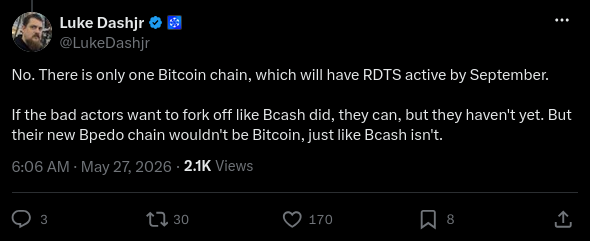
2. BIP-110 will NOT reach the 55% activation threshold and thus nothing of consequence will occur until block 961,632 in early August. At that point, anyone running BIP-110 code will find their node forked off the Bitcoin network.
Yep, that prediction was right on the money.
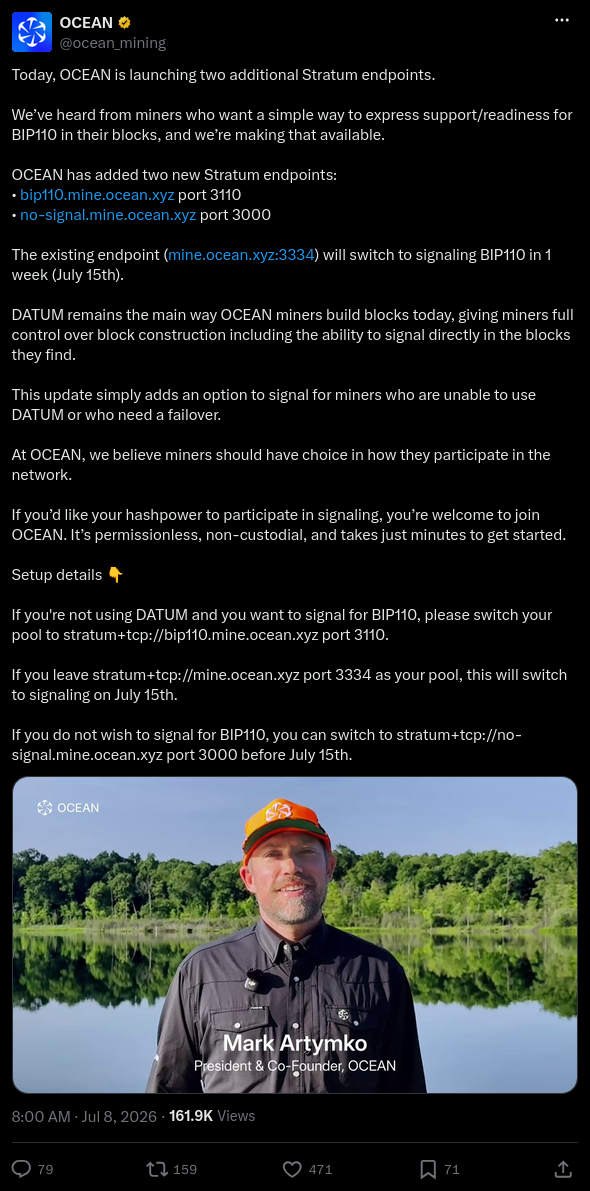
3. If OCEAN is the only pool on the fork (which I consider likely) at around 1% total hashrate, they will produce 1 or 2 blocks per day and it will take nearly 3 years for them to reach the next difficulty adjustment.
Once again, my prediction aged well. OCEAN was the only pool supporting BIP-110 and it did switch BIP-110 to be its default stratum template.
4. Practically speaking, it's unlikely that rational miners would keep going on a minority fork for very long because they won't be able to actually collect their coinbase rewards.
Yep. Turns out there was only one tiny entity that called themselves “Roughnecks” who mined the entirety of the 4 blocks on the BIP-110 fork.
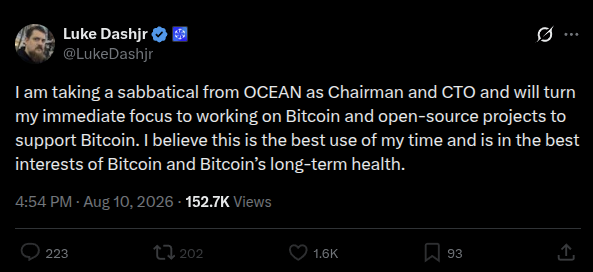
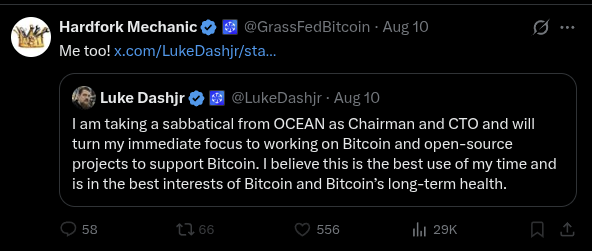
I also made a suggestion 6 months ago that, unfortunately, OCEAN waited until AFTER the failure of 110 to enact. But better late than never, I suppose.
“I believe it would behoove OCEAN investors to inform management that they are not interested in the company being associated with a reckless cult that is herding a lot of people toward running off a figurative cliff by forking themselves off to a dead-on-arrival network. But, as they say, it's none of my business. I don't care what happens to OCEAN, I'm concerned about the unnecessary vitriol, conflict, and brain drain on the ecosystem.”
How Did I Know?
Conspiratorial 110 supporters will surely say that I am a bad actor who is a member of some shady cabal that colluded against them. Nope, it's much simpler than that. Although I laid out many TECHNICAL reasons 6 months ago why BIP-110 was a bad idea, the primary reason it was clearly doomed to fail was from gauging economic weight on each side.
Look at previous contentious Bitcoin forks:
- Bitcoin Cash had multiple billionaires backing it (Roger Ver & Jihan Wu) who controlled massive companies, including the largest ASIC manufacturer. Even with their combined economic weight (and Bitmain swapping tons of BTC for BCH) they were unable to convince the ecosystem to follow their lead.
- Bitcoin Satoshi Vision had a billionaire backing it (Calvin Ayre) who controlled a decent number of companies and hashrate. Even with his economic weight and the reputation of a supposed Satoshi on his side, he was unable to convince much of the (relatively tiny) Bitcoin Cash ecosystem to follow his lead.
Where was the economic weight backing BIP-110? It was a "pleb" movement - very few of the prominent supporters were wealthy or running companies. The biggest company involved was OCEAN which is one of the smallest mining pools in the industry. And if you ask OCEAN leadership, they'll say OCEAN wasn't involved at all and this whole mess was just the "personal opinions" of Luke Dashjr and Bitcoin Mechanic. (LOL)
Previous Bitcoin forks all OFFERED something of economic interest such as increased throughput / lower fees / more functionality. BIP-110 only offered purity / morality / removal of functionality and LESS fees for miners.
Bitcoin is driven by incentives and game theory, not by morality.
— Jameson Lopp (@lopp) April 26, 2026
Bitcoin is "moral money" insofar as the former align to make it impractical for one group to screw over another group to advance their own interests.https://t.co/6WZAwdV44L
The (lack of) markets made this quite obvious. Nobody ever took me up on my public offer to engage in a trustless fork futures contract; instead my offer was met with puritanical posturing that “gambling” is immoral and that I’m a “bad actor” who should not be humored. Once again, this was a failure to understand economic signals on the part of Puritans - fork futures were an important part of the 2017 contentious fork. They showed that there WAS significant economic interest in larger block sizes, which signaled to economic actors like miners, exchanges, and infrastructure providers that it would be worth their time to expend resources supporting the fork at a technical level.
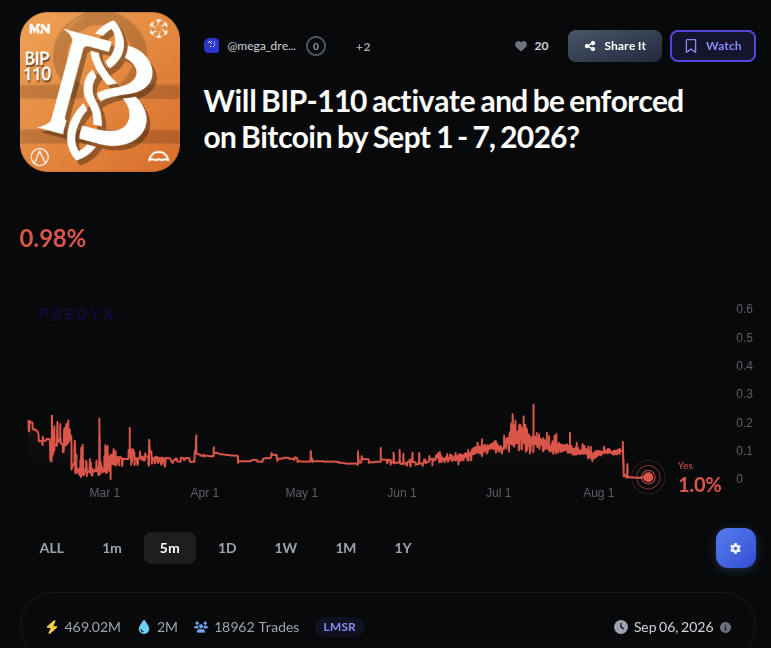
The only operational prediction market for BIP-110 managed to achieve a paltry 4.6 BTC in total aggregate volume and the odds of 110 success mostly stayed below 20%.
How Did We Get Here?
The “spam” debate has been simmering for pretty much the entirety of Bitcoin's history.
The first debate about arbitrary data in the blockchain happened in December 2010 and Satoshi was involved
— Farside Insights (@FarsideInsights) September 29, 2025
On 8th December 2010, Satoshi released Bitcoin version 0.3.18, which included a standardness check, to only include known transaction types
🧵 pic.twitter.com/J95ax5Cgte
If you’re willing to invest an hour and a half in learning the history of Luke Dashjr’s anti-spam crusade, I highly recommend watching this episode of Hell Money Podcast:
If you want to do an incredibly deep historical dive into the technical debates, check out Ava Chow’s 5 hour livestream that reviews discussions on forums, mailing lists, and code change proposals:


If you just want the “too long, didn’t watch” version:
- 2014: OP_RETURN is introduced as a pressure valve, not a data-storage endorsement. Before it, protocols could hide arbitrary data in outputs that looked spendable, permanently bloating the UTXO set. Bitcoin Core 0.9 made small OP_RETURN outputs standard, initially allowing about 40 bytes, so data could at least be marked provably unspendable and pruned from the UTXO set. Core’s release notes explicitly said storing arbitrary data was still discouraged.
- 2014-2015: Counterparty and “Bitcoin 2.0” expose the philosophical split. Token/metadata protocols wanted more room; when OP_RETURN was too restrictive, they could encode data through multisig or other transaction structures instead. This produced the argument that persists today: should policy discourage non-monetary uses, or merely steer unavoidable data into the least harmful encoding?
- 2015: Core loosens OP_RETURN slightly while actual spam attacks hit the network. Bitcoin Core 0.11 raised the default payload limit to 80 bytes. Separately, large “stress tests” flooded Bitcoin with economically trivial transactions, creating substantial mempool backlogs. From then on, “spam” meant two related but distinct things: arbitrary-data storage and any low-value use competing for scarce blockspace. If you want to do a deep dive into those spam attacks, I published this analysis 5 years ago:
Jameson Lopp
- 2016–2021: an uneasy compromise forms around fees + policy. Bitcoin consensus remains fairly permissive, while Bitcoin Core’s standardness/relay policy rejects or discourages some valid transactions. The implicit bargain is that miners ultimately choose what goes in blocks and fees price scarce space; relay policy can reduce network abuse without changing consensus. This consensus-vs-policy distinction becomes central to every later fight. During this period we saw more use of OP_RETURN to anchor other systems into the blockchain. I myself wrote this article about Bitcoin's value as a trustworthy historical record in 2016:
Jameson Lopp
- SegWit (2017) and Taproot/Tapscript (2021) change the economics of publishing data. SegWit gives witness bytes a weight discount; Tapscript removes the old 10,000-byte script-size limit, leaving script size largely bounded by transaction/block weight. Neither upgrade was done to facilitate NFTs or data storage, but together they created a cheaper way to publish arbitrary data. The witness discount was actually done to correct an incentive imbalance between the cost of creating UTXOs and the cost of consuming UTXOs.
- 2023: Inscriptions detonate the debate again. Inscriptions encode image data inside Taproot script-path witnesses using OP_FALSE OP_IF … OP_ENDIF “envelopes.” Large images, text and token protocols such as BRC-20 could therefore be placed fully on-chain while remaining consensus-valid. Critics called this an exploit or spam; supporters called it permissionless fee-paying use of blockspace.
- 2023–2024: the fight shifts to whether nodes should filter inscriptions. Luke Dashjr and others argued that inscriptions circumvent the intent of -datacarriersize and advocated stronger relay filters; Bitcoin Knots implemented stricter approaches. Bitcoin Core did not broadly blacklist inscriptions, reflecting the counterargument that determined users can route transactions directly to miners or disguise data in other valid structures, making such filtering brittle.
- 2025: the original OP_RETURN logic flips back on itself. Core developers observed that the ~83-byte policy was now causing protocols like Citrea to implement workarounds by using more harmful techniques, including forever-unspendable outputs that burden the UTXO set. Antoine Poinsot proposed relaxing OP_RETURN policy on the grounds that discouragement had become ineffective; opponents argued that removing the limit would normalize blockchain data storage, increase bloat and abandon an important anti-spam norm.
- 2025: Bitcoin Core effectively uncaps OP_RETURN relay policy, but does not change consensus. Core 30 raised default -datacarriersize to 100,000 bytes and allowed multiple OP_RETURN outputs; users can still configure the old restriction. This was done in REACTION to new network dynamics rather than to CREATE new network dynamics; the evidence is in the blockchain itself.
After talking with @Princey21M in Prague, I realized Bitcoin Core v30’s OP_RETURN policy change isn’t obvious to many: it didn’t create large OP_RETURN usage, it reacted to usage that already existed by removing a gate that wasn’t actually working. pic.twitter.com/aSMvwLx89J
— l0rinc (@L0RINC) June 13, 2026
- 2026: BIP-110 seeks to restrict ability to encode arbitrary data. The narratives supporting BIP-110 get more and more desperate and devolve into extreme rhetoric around child sexual abuse material.
There’s a recurring pattern in this debate: restrict one data channel → users find another → developers argue whether to tighten filters further or make the least-damaging channel easier to use.
Let's keep in mind that the original motivation by the anti-spam movement was not originally about bad images - it was about perceived degenerate behavior on a blockchain which they had mythologized, declared pure and pristine as being only for monetary usage. When Bitcoin was revealed to NOT be a perfect and pure technology/money, it began a process of deconstruction of the Puritan perspective, which over the years devolved into full-blown delusion. This delusion led to the formation of various flawed narratives for why BIP-110's activation was mechanically forced, game-theoretically guaranteed, or socially inevitable.
I believe that this is an interesting case of the Dunning-Kruger effect. Essentially, we see a small group of folks for whom Bitcoin has become a significant part of their life and identity. They have absorbed many memes over the years about what Bitcoin is and what it means to be a Bitcoin supporter. Many of these folks have only been around Bitcoin for 1 market cycle or so and have mostly consumed memes that are several generations dumbed-down from their original sources. Several years ago I attempted to explain this memetic devolution via a comprehensive essay about the history of Bitcoin Maximalism.
Jameson Lopp
As such, instead of reasoning about the nature of Bitcoin and its game theory from first principles, Puritans trusted a small set of thought leaders to tell them what to believe, and those leaders often resorted to mental gymnastics to console themselves that Bitcoin MUST operate in a certain way. Over the past year, these thought leaders have come up with a variety of narratives and predictions that have not aged well.
Scaling and Spam Debate Similarities
What is the disagreement actually about? If you recall the scaling debates, that disagreement boiled down to a single question:
Should Bitcoin be optimized for low cost of transacting at the expense of high cost of validating the system or should it be optimized for low cost of validating the system at the expense of potentially high cost of transacting?
I think the ultimate distillation of the spam debate boils down to:
Should Bitcoin be optimized for lower cost of transacting and validating the system at the expense of making subjectively disapproved use cases more difficult or should it seek to promote a robust free market for block space, whatever the use case may be?
This isn’t quite as satisfying a question because I think the premise is fundamentally wrong. That is, the underlying assumption that non-monetary usage increases the cost of transacting and of running a node. Yes, for short periods there have been high fee environments from non-monetary use but they proved unsustainable. From the node resource requirement perspective, non-monetary data is actually cheaper to verify because the node just skips over it. There is the claim that it increases the cost of storage, though this claim is also problematic because of:
- The block size limit.
- OP_RETURN usage results in smaller blocks and fewer UTXOs in the UTXO set.
- Witness stuffing is speculative as to what transactions would be stored if the witness stuffed transactions were never created. Even in a worst case scenario we’re talking about the difference between 2 MB blocks and 4 MB blocks, which over the long run both lead to nodes continuing to become cheaper due to the deflationary nature of computer hardware.
Just like what occurred during the scaling debates, discourse turned to dogma as desperation set in.
Dogma: "Doing X is an attack on Bitcoin!"
— Jameson Lopp (@lopp) February 28, 2017
Discourse: "I disagree with doing X because my vision for Bitcoin is Y."
I was not the only one to notice several similarities between them.
Let me make this joke just once more:
— PakoVM (@PakoVM) May 7, 2025
Blocksize wars - Any% speedrun (World record) https://t.co/MGJ9XOAtFp pic.twitter.com/hfUtoHh0Tp
Greg Maxwell astutely pointed out (with plenty of citations) that the fundamental narrative of BIP-110 being "anti-spam" was in and of itself quite confusing. The BIP itself admitted that it's technically impossible to stop arbitrary data, but the primary rallying cry of the movement was that supporters were helping to stop the spammers and kick them off the network. As such, BIP-110 was anti-spam when it was convenient and it was ineffective at stopping spam when propagandists were pressed to be honest. As such, the narrative had to focus less on the technical merits of the proposal and more on the cultural aspects: that BIP-110 was "sending a message" that certain use cases of the protocol would not be tolerated.
Another similarity was that, much as Roger Ver was touted as "Bitcoin Jesus" during the scaling debates, Luke Dashjr was positioned as the savior of Bitcoin during spam debates.
At the heart of OCEAN's journey: @LukeDashjr, our co-founder and "guardian angel" of Bitcoin. His values and love for #Bitcoin are the pillars of our mission and its long-term sustainability.
— OCEAN (@ocean_mining) December 2, 2023
Thank you, @Jack Dorsey. pic.twitter.com/6sdUwXNHuI
Luke himself seems to have bought into this narrative and has developed quite the savior complex.
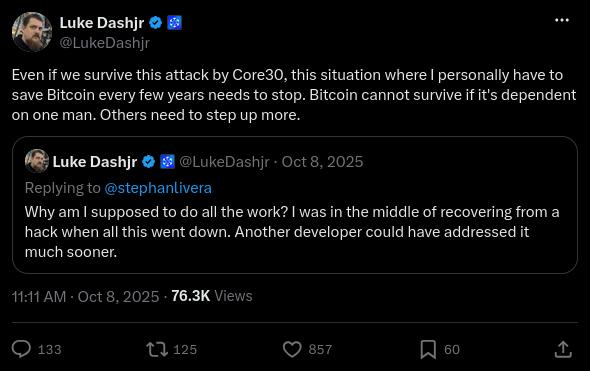
Think of the Children
But that's not all! It seems the lowest common denominator for many political and philosophical arguments ends up being the protection of children and future generations. This, too, occurred during both debates, though the 110 debate took it to new extremes. Those who were around for the scaling debates may recall the massive mockery of Roger Ver's claim that "babies are dying" as a result of the block size not being increased...
Things took a turn for the worse when the desperation led to Puritans leaning on extreme arguments regarding child exploitation. It didn't take long for people to get tired of the vitriol from grievance merchants.
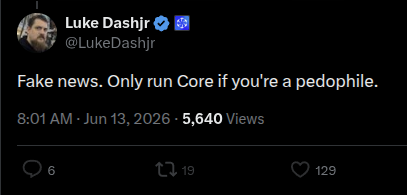
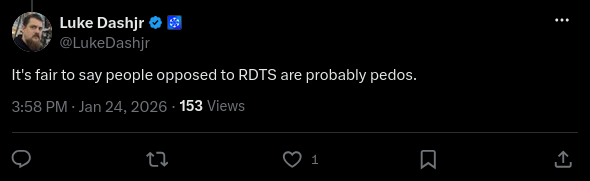
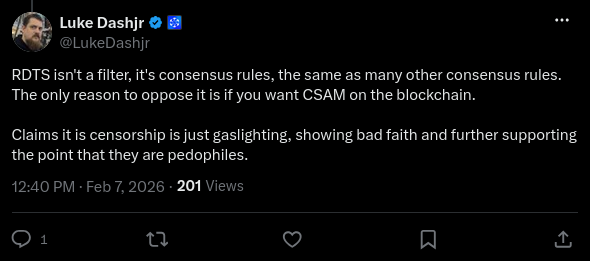
The amazing thing is that Luke got so obsessed with CSAM that folks were able to run statistical analyses on his posts.
Thread: @Lukedashjr CSAM / Pedo / CP Posting By The Numbers
— LayerTwo Labs (@LayerTwoLabs) July 10, 2026
Account-wide since July 2012:
- 159,919 total posts
- 0.27% (424) of all posts contain “CSAM”, “pedo”, or whole-word “CP”
- first matching tweet: March 20, 2018
- highest combined term month: 92 posts in October 2025
-… pic.twitter.com/yTFuq0YKJN
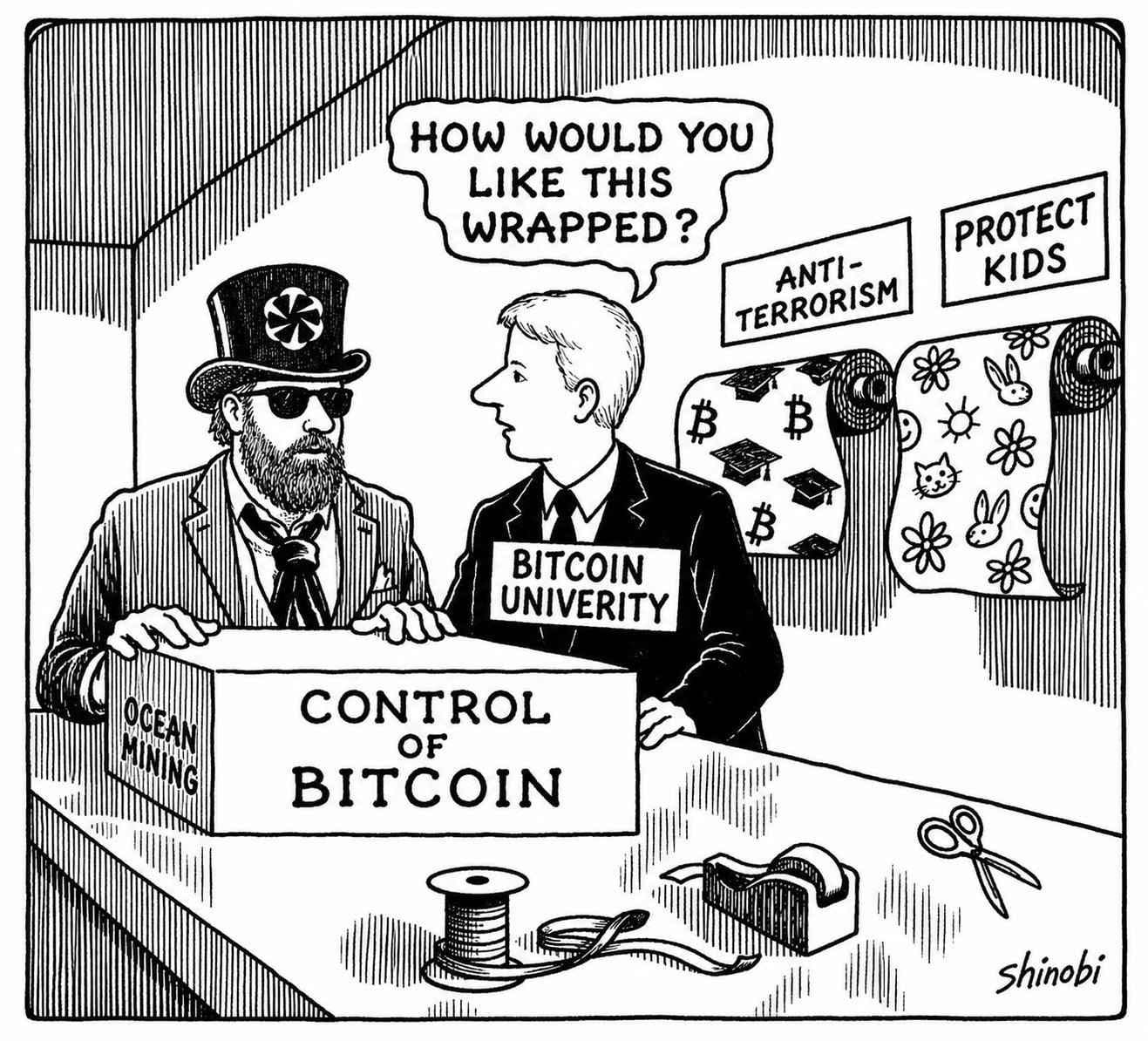
Of course, this is nonsensical. Saying that you support pedophilia or distribution of child porn because you understand the futility of fighting arbitrary data on a censorship resistant protocol is like saying someone supports school shootings because they support the right to bear arms. This line of propaganda has been in use for decades and is so prevalent that many will likely recognize the meme this is based upon.
Development Screwups
The initial release candidate (RC1, Dec 10, 2025) of the BIP-110 client had multiple problems:
- Functional tests failing.
- Fuzz tests failing.
- Tests stubbed out with early returns.
- Binaries uploaded before proper cryptographic signatures applied.
Bitcoin Core maintainer Michael Ford advised waiting for a later RC, and developer Rob Hamilton noted it was “very possible [the client] could still have consensus bugs.” He would later be proven correct... multiple times.
Bitcoin Core developer l0rinc found a significant bug in February.
# BIP-110 ReducedData: script-execution cache poisoning via activation-boundary reorg… pic.twitter.com/1mEkxKHlCN
— l0rinc (@L0RINC) February 13, 2026
In June, Jonathan Bier identified that BIP-110 rules (particularly restrictions on OP_IF/OP_NOTIF in Tapscripts and certain Taproot features) can make scripts/addresses generated by Miniscript-supporting wallets unspendable after activation, but the BIP-110 client's wallet still allowed users to create addresses with those features. Quite the footgun and oversight.
Bitcoin Knots is the main activation client for BIP-110, which then goes on to enforce BIP-110. The irony here is that Bitcoin Knots wallet itself breaks its own rules & if one uses Knots, you can lose your funds. To demonstrate this, we ran the latest version of Knots
— Farside Investors (@FarsideUK) June 30, 2026
[2/5] pic.twitter.com/EWAnpIQvaJ
Knots managed to degrade their node syncing performance by unintentionally disabling the script cache:
 bitcoinknots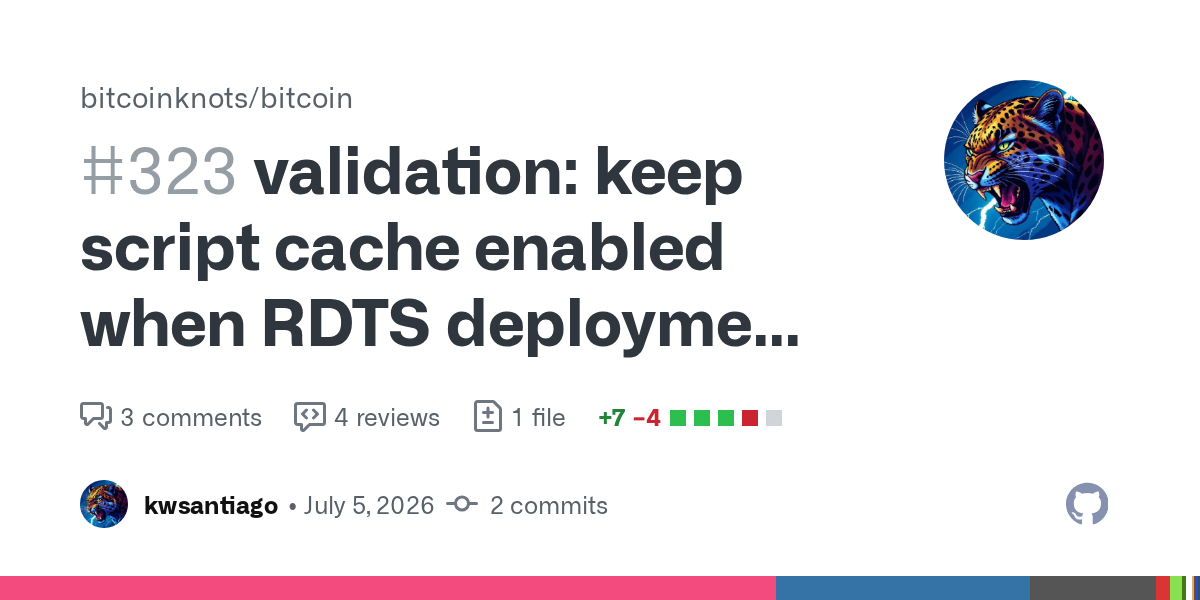
On July 18, a new nym appeared and "Dathon Pwn" explained to us that BIP-110 had a critical edge case bug because turning on the new rules does not necessarily make the node recheck blocks it accepted under the old rules.
As a final icing on the cake, just 2 weeks before BIP-110's mandatory signalling when it forked off and stalled out, it was discovered that the BIP-110 implementation included an undocumented 8th consensus rule.
bitcoin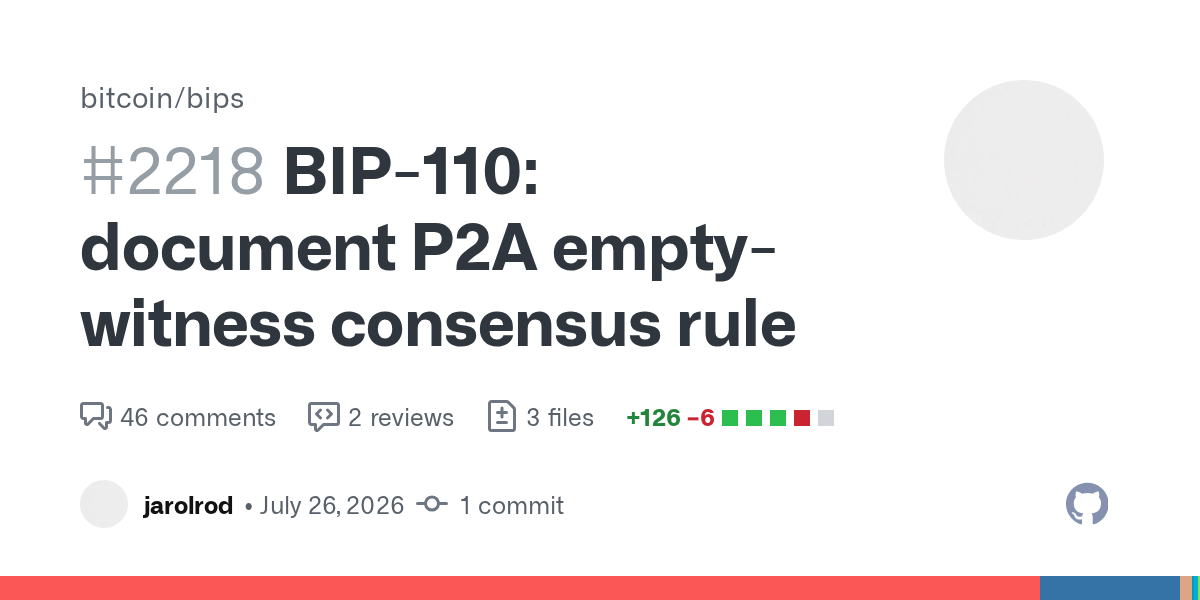
BIP-110’s Impotence
As we’ve been saying all along, you can’t stop arbitrary data from entering the blockchain. There are simply too many avenues that are only limited by people’s creativity.
As such, numerous examples of BIP-110 compliant methods for embedding arbitrary data have been implemented in order to continually prove this point.
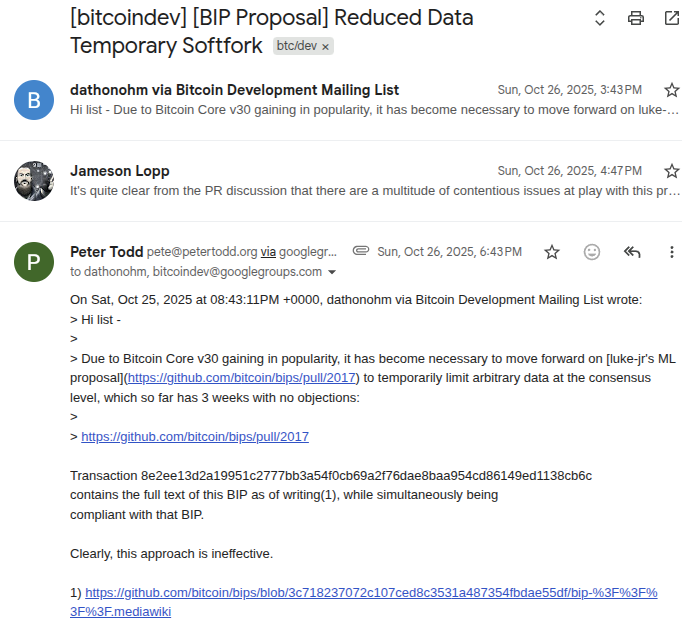
A mere 3 hours after Dathon Ohm published the RDTS BIP to the Bitcoin Development Mailing List, Peter Todd embedded the full text of the BIP itself into a transaction that complied with the proposed restrictions.
Others embedded larger data (like images) using paths that avoid the targeted restrictions (e.g., non-Taproot, non-OP_RETURN methods).
Update that you've been all waiting for: I made a contiguous image file that can be misinterpreted by the BIP-110 Bitcoin fork as an entire transaction and contiguously stored in the BIP-110-compliant chain!
— MⒶrtin HⒶboⓋštiak [BEFORE! Jan/3➞₿🔑∎, LNP/BP] (@kixunil) February 28, 2026
Read the details and verify at:https://t.co/MhgWucTohS
Fun fact: It is possible to create a transaction with almost 4 MB of contiguous arbitrary data even under BIP-110/RDTS rules (tested with UASF BIP-110 v0.1).
— Vojtěch Strnad (@vostrnad) February 11, 2026
SHA-256: 76462d44e25689ce1aa6d3b3749c4e249da3eaee4486e4c4c469bb5e7b1d98f2
(friends can DM for preimage)
RIP 110 explores the concept that every Bitcoin transaction is a JPEG.https://t.co/SVEW5UyCzf
— lifofifo ◉ (@lifofifo) July 26, 2026
A BIP 110-compatible TX with 110 inputs, each contributing one row to a 160×110 BMP, byte-for-byte.
CONTIGIOUS 52KB image file.
No data pushes. No special encoding. pic.twitter.com/iTomsxftkh
Ultra high resolution image files embedded contiguously in BIP110-valid txs? No problem.
— Steve (@steverabinow) July 24, 2026
-No Inscriptions-style decoding
-Doesn't use Taproot
-Knots policy standard
-Cheaper than Inscriptions (fee/quality)
-4x cheaper than OP_RETURN
Introducing JXL-n-hide.
BIP110 taketh away OP_IF, but giveth OP_PLENTY.
— Steve (@steverabinow) July 21, 2026
Introducing a novel way to encode arbitrary data in *contiguous* bytes. Up to 2MB fully BIP110 compliant.
OP_PLENTY encodes each 4 bit nibble of the raw data into a tapscript opcode. Decoding is trivial: take the opcode mod 22.
It's BIP110 ADVENT season (Arbitrary Data Validly Embedded in Native Transactions)
— Steve (@steverabinow) July 27, 2026
Today: Animated GIFs
(Still ~4x cheaper than OP_RETURN & contiguous)
bitcoin-cli getrawtransaction 740eb97b05afa26046b0d5b0edcbca2b5a94c84b8ca5170a0246ddaa3261f288|xxd -r -p|tail -c+154>x.gif
BIP110 ADVENT continues. Today: PDFs.
— Steve (@steverabinow) July 28, 2026
The Bitcoin Whitepaper embedded contiguously in a BIP110 valid (and Knots standard!) transaction.
- Wouldn't fit in a Core-standard OP_RETURN
- Fits in BIP110 blocks for ~4x cheaper pic.twitter.com/ROY6QebY2F
BIP110 ADVENT. Big one today.
— Steve (@steverabinow) July 29, 2026
Introducing BIPflix: Contiguous MP4s!
-Too big for OP_RETURN
-4x cheaper
-BIP110 valid
-High quality
bitcoin-cli getrawtransaction 06214483dcbf9f2025f9709aa5a7dce85277a8ce15076d2d0029f3d64f4bc7b6 | xxd -r -p | tail -c +166 > l.mp4 pic.twitter.com/FIH0ydI3rh
BIP110 ADVENT: nerd edition.
— Steve (@steverabinow) July 30, 2026
Today: contiguous binary executables (WASM)
The demo program is a quine. It'll make an exact copy of the tx it's embedded in. (Check the OP_RETURN message)
-BIP110 valid (Knots standard, too) pic.twitter.com/twL1kx9XlM
BIP110 ADVENT: Endgame
— Steve (@steverabinow) August 7, 2026
Embed *entire directories* of arbitrary data contiguously in BIP110 valid blocks using compressed archives (tar.gz)
-Knots standard (exclusively!) up to 400kB
I had Roughnecks mine a tx with some of the most dangerous malware in the world. Not for the…
And furthermore, just for fun, many of the protocols that BIP-110 supporters were hoping to kick off the Bitcoin network showed how trivial it is to update their methods to work around the restrictions.
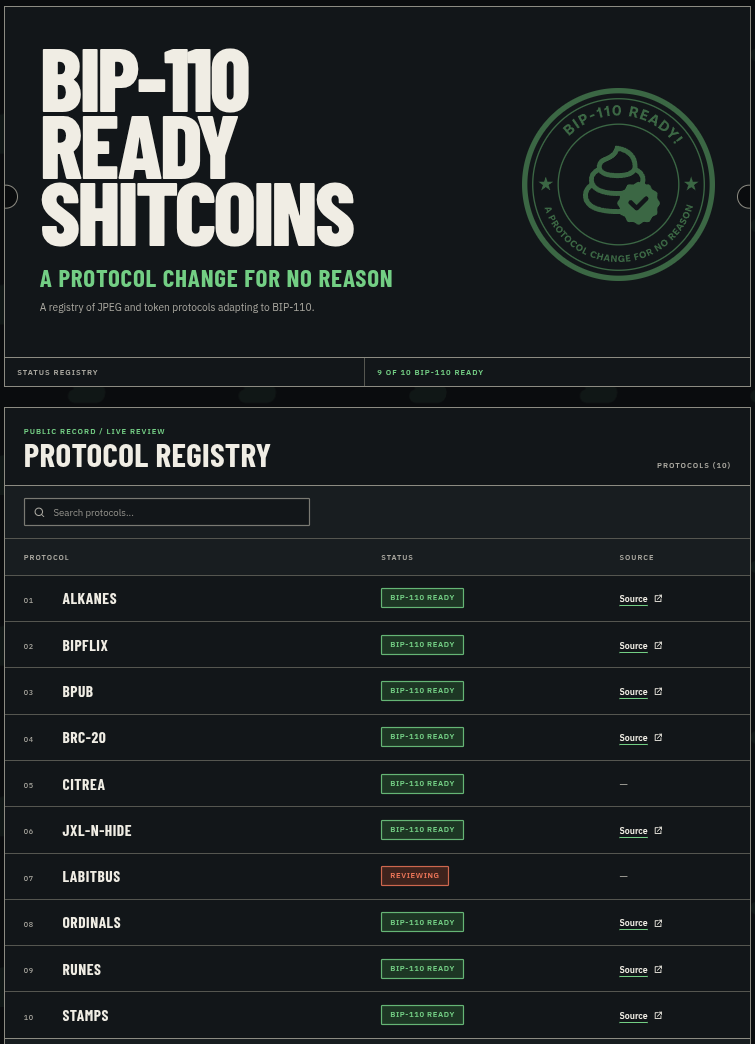
Poorly Aged Anti Spam Arguments
Let's not forget that the anti-spam position had to keep pushing back the goalposts as each of their claims was disproven.
Originally, Puritans claimed that policy is all that matters; consensus changes aren’t helpful or necessary to stop spam.
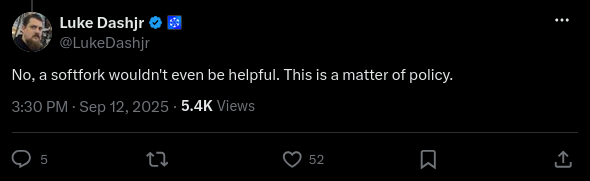
However, this was handily disproven by "sub 1 sat per vbyte summer" in 2025 where many bitcoin users simply started routing around the default minimum 1 sat/vb node relay policy in order to save themselves money on transaction fees. As such, this once again led to protocol developers discussing the best way to handle a shift in network dynamics that had occurred organically and spontaneously. This phenomenon also led to us gaining a better understanding of what came to be known as the "tolerant minority" game theory of transaction propagation. It turned out that with sufficiently well connected nodes, you didn't even need 10% of nodes on the network running a looser relay policy in order for the more restrictive default policy to be made ineffective. In reality, you only need to run a handful of well connected nodes.
 glozow
There was also a loud narrative after Bitcoin Core v30 was released that its less restrictive relay policy was “blown out” and would “open the floodgates” for spammers.
Only 0.17% of last week’s OP_RETURN output data was added by OP_RETURN output scripts with over 83 bytes. The rest would be accepted by nodes enforcing BIP110. pic.twitter.com/mKW1FFx5pv
— Murch (@murchandamus) June 3, 2026
Puritans also spread FUD that the OP_RETURN size increase would be abused to crash nodes.
 Aaron Wise
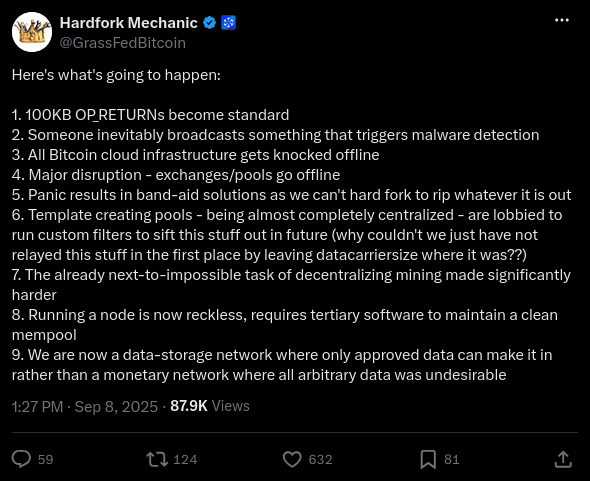
I tried to get them to show some conviction back then (and hopefully make a nice profit from them being wrong) to no avail.
Do filter folks believe the FUD they're spreading? Let's find out.
— Jameson Lopp (@lopp) September 10, 2025
I challenge @LukeDashjr, @GrassFedBitcoin, @mattkratter, et al to put their money where their mouths are. Let's devise a BTC bet based around whether or not a massive node outage occurs due to OP_RETURN data.
Eventually after the release of Bitcoin Core v30 turned out to be a nothingburger, the Puritan movement had to pivot.

Once the anti-Core v30 movement transformed into the pro BIP-110 movement, the narratives started evolving faster and the pretzel logic got weirder as the proponents spiraled toward downright delusion.
Arguments Employed by BIP-110 Supporters
- The activation code is designed not to fail. BIP-110 uses a modified BIP9 process with no timeout, a 55% miner-signaling threshold, a max activation height, and a mandatory-signaling period. The spec says the normal FAILED state is never reached, and that mandatory signaling ensures lock-in no later than the specified height. Supporters treat this as the strongest “it will happen” argument. (BIP-110)
- Mandatory signaling turns non-signaling into a punishable act. During the mandatory window, BIP-110 nodes reject blocks that do not signal bit 4. Supporters argue miners therefore face a forced choice: signal, or risk mining blocks that enforcing nodes reject. (BIP-110)
- The 55% threshold is much easier than the usual 90–95% style soft-fork threshold. BIP-110’s authors justify the lower threshold by saying the fork is temporary and urgent. Supporters use that lower bar to argue that activation can happen with a simple majority-plus rather than near-unanimity. (BIP-110)
- Signaling costs miners almost nothing.The pro-BIP game-theory argument says setting the version bit is operationally cheap, while not signaling can become expensive if a signaling majority emerges. Therefore, supporters call signaling a weakly dominant strategy. (melvin.me / archive.is)
- Not signaling costs miners entire block rewards. Supporters argue that if 55% of hashrate enforces BIP-110, the non-signaling 45% risks orphaned blocks during the fork contest. One pro-BIP analysis frames this as risking the full block subsidy to defend a much smaller inscription-fee stream. (melvin.me / archive.is)
- Block subsidy dwarfs inscription revenue. The supporter argument is that miners will not rationally risk 3.125 BTC block subsidies to preserve relatively small data/inscription fees. This is used to say miners may posture against BIP-110 but will flip when the deadline nears. (melvin.me / archive.is)
- Low current signaling is dismissed as strategically meaningless. Supporters argue miners have little incentive to signal months early because signaling is measured per 2,016-block period, not cumulatively. In that view, low signaling today does not predict failure; the “real” move would be a late flip. (melvin.me / archive.is)
- They expect a last-minute cascade. A common pro-BIP model says once signaling approaches roughly 30–40%, holdouts will realize the risk of being left behind, and signaling will cascade quickly to 55%. (melvin.me / archive.is)
- They invoke the 2017 SegWit/UASF precedent. Supporters compare BIP-110 to the 2017 UASF pressure campaign, arguing that apparent deadlock can flip quickly once a credible deadline forces miners to coordinate. (The Bitcoin Manual) I found this argument particularly laughable because the BIP-148 UASF of 2017 never actually triggered - it was defused by BIP-91.
- “Users, not miners, define Bitcoin.” The UASF argument is that miners only produce blocks; economically relevant nodes decide which blocks count as valid Bitcoin. If exchanges, custodians, wallets, merchants, and users enforce BIP-110, miners must follow the valuable chain or mine coins the market discounts. (The Bitcoin Manual) This is actually true, of course, the supporters always shirked around the fact that the BIP had no support from economically relevant entities.
- Exchanges and custodians supposedly have an incentive to prepare “just in case.” Supporters argue that the cost for an exchange to run BIP-110-compatible infrastructure is small, while the cost of being on the wrong side of a chain split could be severe. This creates a claimed self-fulfilling loop: preparation by economic actors makes activation more credible, which makes more actors prepare. (melvin.me / archive.is)
- Mining-pool concentration makes a fast flip plausible. The pro-BIP argument is that a small number of large pool operators can move enough hashrate quickly, so the public does not need to see slow, organic growth for activation to become real. (melvin.me / archive.is)
- The proposal is temporary, so resistance should be lower. BIP-110 is framed as a one-year intervention that auto-expires after 52,416 blocks. Supporters use this to argue that hesitant users can accept it as a reversible emergency measure rather than a permanent redesign of Bitcoin. (BIP110.org / archive.is) This was also laughable, as no one truly expected Puritans to just give up after a year - it had me thinking of the saying that "there's nothing more permanent than a temporary government program."
- It claims to preserve monetary use cases. This BIP-110 site says “all known monetary use cases” remain functional, while restricting arbitrary data storage. Supporters use this to argue that most economically important users should not object because payments, custody, Lightning-related uses, exchange withdrawals, and ordinary Bitcoin transfers are supposed to keep working. (BIP110.org / archive.is)
- Existing UTXOs are largely protected by a grandfather clause. The spec exempts inputs spending UTXOs created before activation. Supporters use this to answer the “funds will be frozen” objection, though the BIP itself is more cautious and admits some unlikely edge cases cannot be ruled out absolutely. (BIP-110)
- It is a soft fork, not a hard fork. Supporters argue this matters because stricter validity rules can, in principle, be enforced by upgraded nodes without forcing every old node to upgrade immediately. That makes the change easier to coordinate than a hard fork. BIP-110 is explicitly categorized as a consensus soft fork. (BIP-110)
- Bitcoin should be money, not data storage. This is the core philosophical argument. Supporters say BIP-110 “refocuses” Bitcoin on being sound, permissionless money and rejects arbitrary data storage as an unsupported use case. (BIP110.org / archive.is)
- Arbitrary data imposes costs on node operators who do not get paid. The BIP’s rationale says data-storage users pay miners once, but node operators bear the ongoing burden of downloading, storing, and serving that data. Supporters use this externality argument to say the fee market alone cannot solve the problem. (BIP-110)
- Unchecked data storage threatens node decentralization. Supporters argue that more arbitrary data makes nodes more expensive to run, which weakens the decentralization that enforces Bitcoin’s 21 million supply and censorship-resistant monetary rules. (BIP-110)
- Data storage competes with payments and may push users toward custodians. The BIP says non-monetary data competes with payment transactions, raises costs, and encourages reliance on third-party processors, which supporters frame as harmful to censorship resistance. (BIP110.org / archive.is)
- They frame inscriptions as exploiting a known vulnerability. Supporters point to CVE-2023-50428, which describes datacarrier size limits being bypassed by obfuscating data as code using patterns such as OP_FALSE OP_IF; the CVE record is disputed, but supporters use it to frame BIP-110 as a patch rather than censorship. (NVD)
- They claim the proposal is empirically effective. Pro-BIP articles cite simulations claiming BIP-110 would filter a large share of non-financial transactions while producing zero detected false positives against legitimate financial transactions in the sampled data. This is used to argue that the benefits are concrete while the objections are mostly hypothetical. (Binance)
- They argue opposition is mostly “edge cases” and “vaporware.” Some supporter pieces explicitly say the objections concern rare Tapscript patterns, undeployed BitVM-like systems, or theoretical future use cases, while the spam/data-storage problem is already large and measurable. (melvin.me / archive.is)
- Legal-risk reduction is used as a motivation. Supporter-linked material argues that arbitrary data on-chain creates legal exposure for node operators, especially if objectionable or illegal content is replicated by every full node. That claim is used to argue that node operators have a strong reason to support restrictions. (BIP110.org / archive.is)
- They say one-click install paths make node adoption easy. The official BIP-110 site provides install paths for Bitcoin Knots, Start9, Umbrel, myNode, Parmanode, and Docker. Supporters use this to argue that node adoption can grow fast because the activation client is not hard to run. (BIP110.org / archive.is)
- They cite Knots growth and BIP-110 node signaling as momentum. Coinbase noted in March 2026 that a BIP-110 reference implementation existed in a Bitcoin Knots fork and that Knots’ node share had grown sharply versus June 2025. Supporters interpret that as evidence that Core is losing unquestioned dominance and that BIP-110 has a real base. (Coinbase) Of course node counts are trivial to inflate, but that got glossed over because the charts made it look like adoption was occurring.
- They cite early miner signaling as proof the process has begun. CoinDesk reported that Ocean mined the first block signaling support for BIP-110 in March 2026. Supporters use such events symbolically: not as sufficient support by itself, but as evidence the idea has moved from talk to on-chain signaling. (CoinDesk)
- They argue Bitcoin’s long-term price/value depends on solving this. Some advocacy articles go further and say Bitcoin’s path to much higher valuations depends on preserving cheap, decentralized verification. Their argument is that large capital will only trust Bitcoin if ordinary users can keep running validating nodes. (Binance)
- They argue “temporary now, reassess later” is a Schelling point. Supporters say BIP-110 does not require settling Bitcoin’s entire long-term data-use philosophy immediately. It buys a year, pushes data users elsewhere, and lets the community refine or reject future action after the temporary period. (BIP110.org / archive.is)
- They portray inaction as more dangerous than activation. The pro-BIP frame is that every day of non-monetary data growth permanently burdens every node, while BIP-110’s risks are temporary and bounded. That asymmetry is used to argue that rational users should choose action. (melvin.me / archive.is)
- Claims of asymmetric advantage due to wipeout risk: https://stacker.news/items/1413227
- Hilarious “activation probability model” cope site by Rene Cuard that was showing greater than 50% likelihood of BIP-110 winning. For example, here's a snapshot of the June 6th “activation probability.”
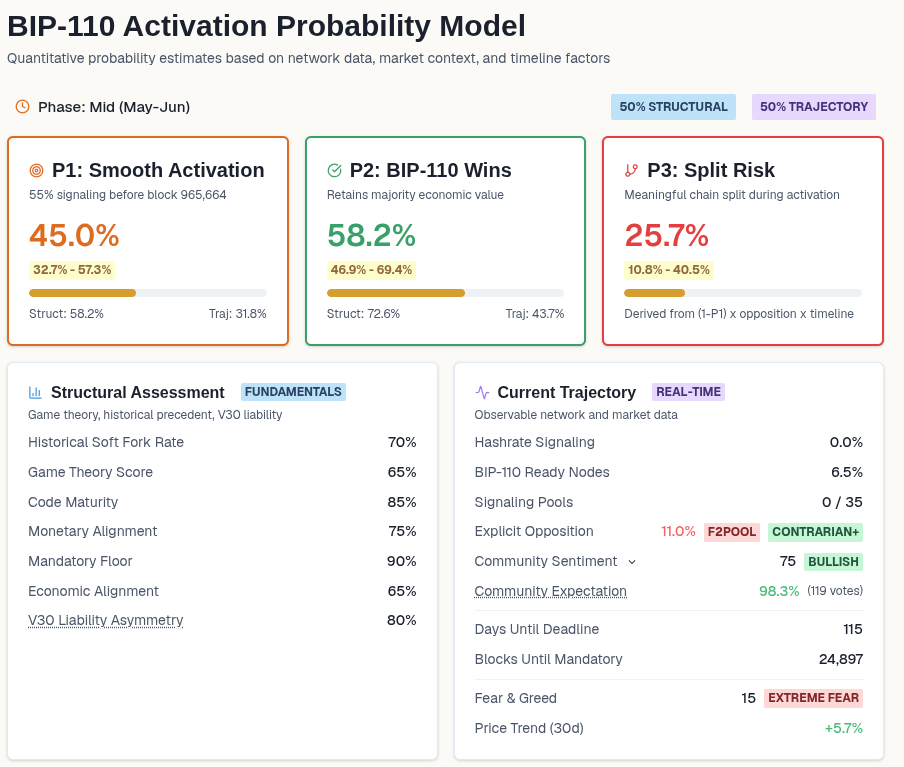
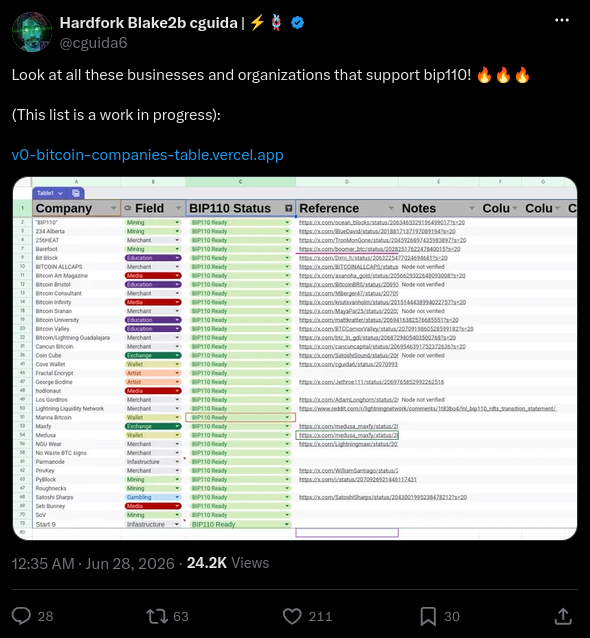
This effort to list supportive economically relevant entities didn't go over very well as it turned out that many of the entries were added without supporting evidence.
The big assumption 110 proponents made was economic support. Sure, the activation logic was “mandatory” inside of BIP-110 software, but whether a (soft or hard) forked chain is treated as “Bitcoin” depends on miners, exchanges, wallets, custodians, users, and markets coordinating around it. It was clear to all of us who weren't trapped inside the Puritan echo chamber that the economic support simply didn't exist.
Poorly Aged Predictions
Quite a few BIP-110 supporters made outrageous claims and predictions. Although it’s impossible to cover them comprehensively, I think it’s important that we get many of the more ridiculous and off-base predictions on the permanent record. Supporters should be embarrassed by these statements, but need not bother deleting them - I’ve ensured that they are archived for all eternity. You can delete a social media post, but the internet never forgets.
The following statements are in chronological order so that you can observe the descent into madness. Let’s begin.
Luke’s Statements
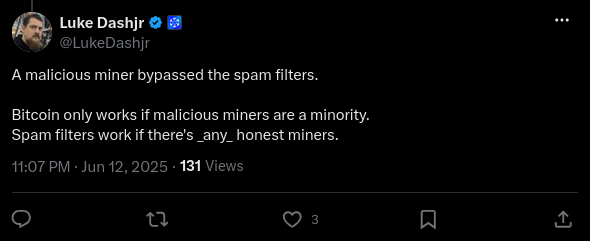
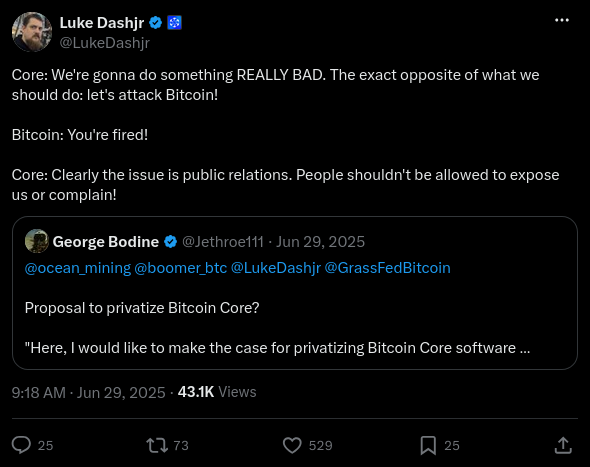
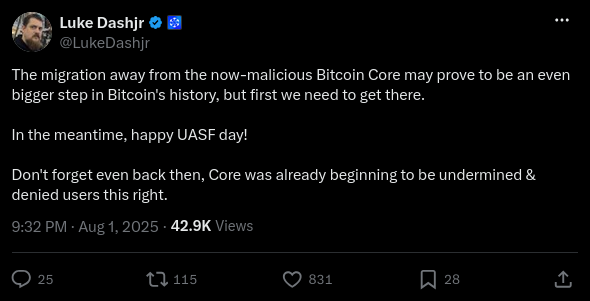
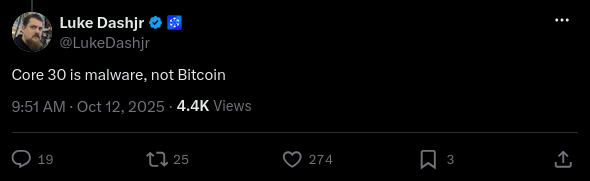
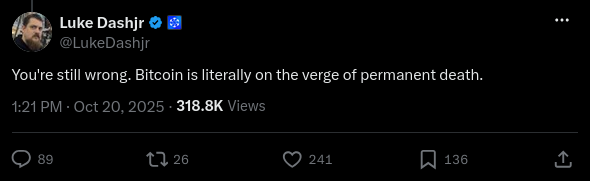
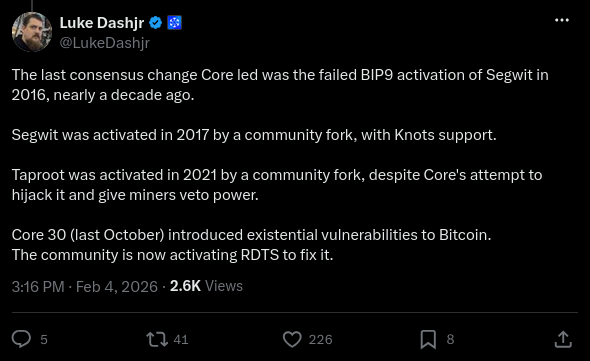
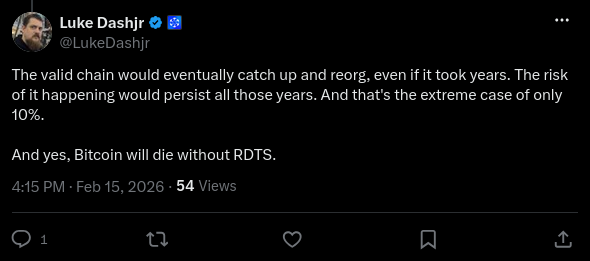
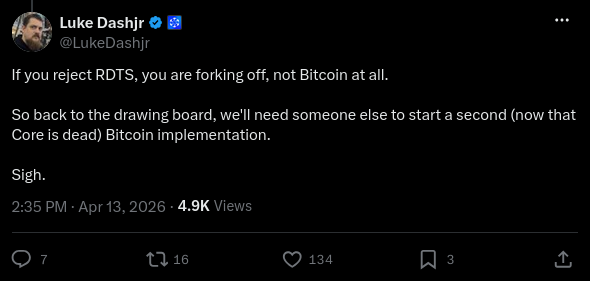
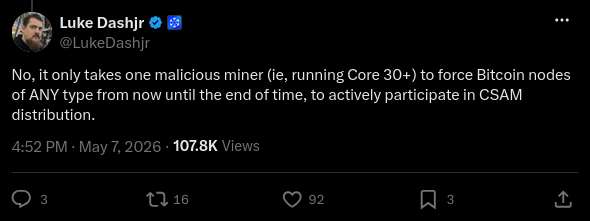
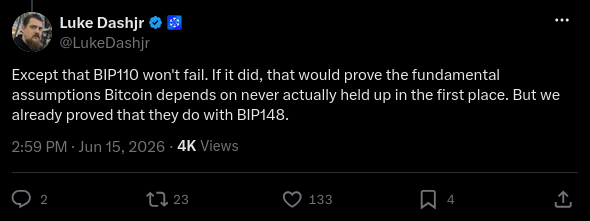
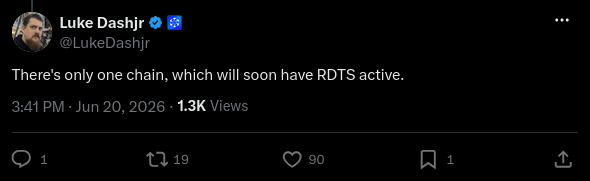
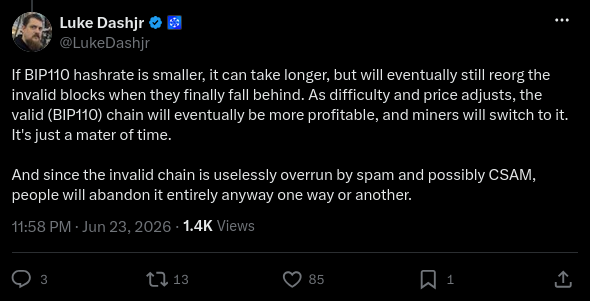
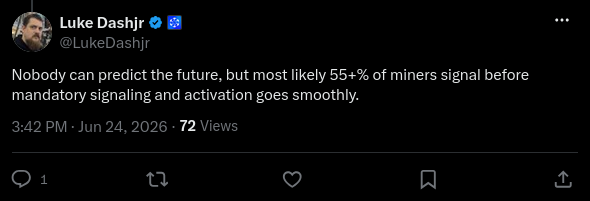
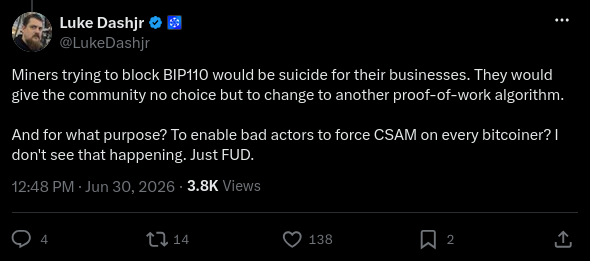
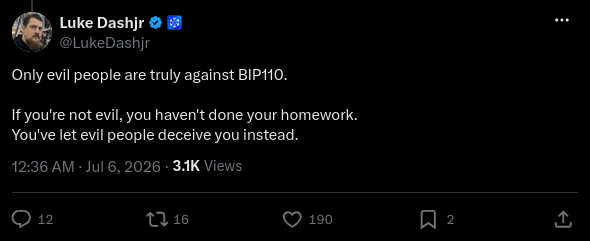
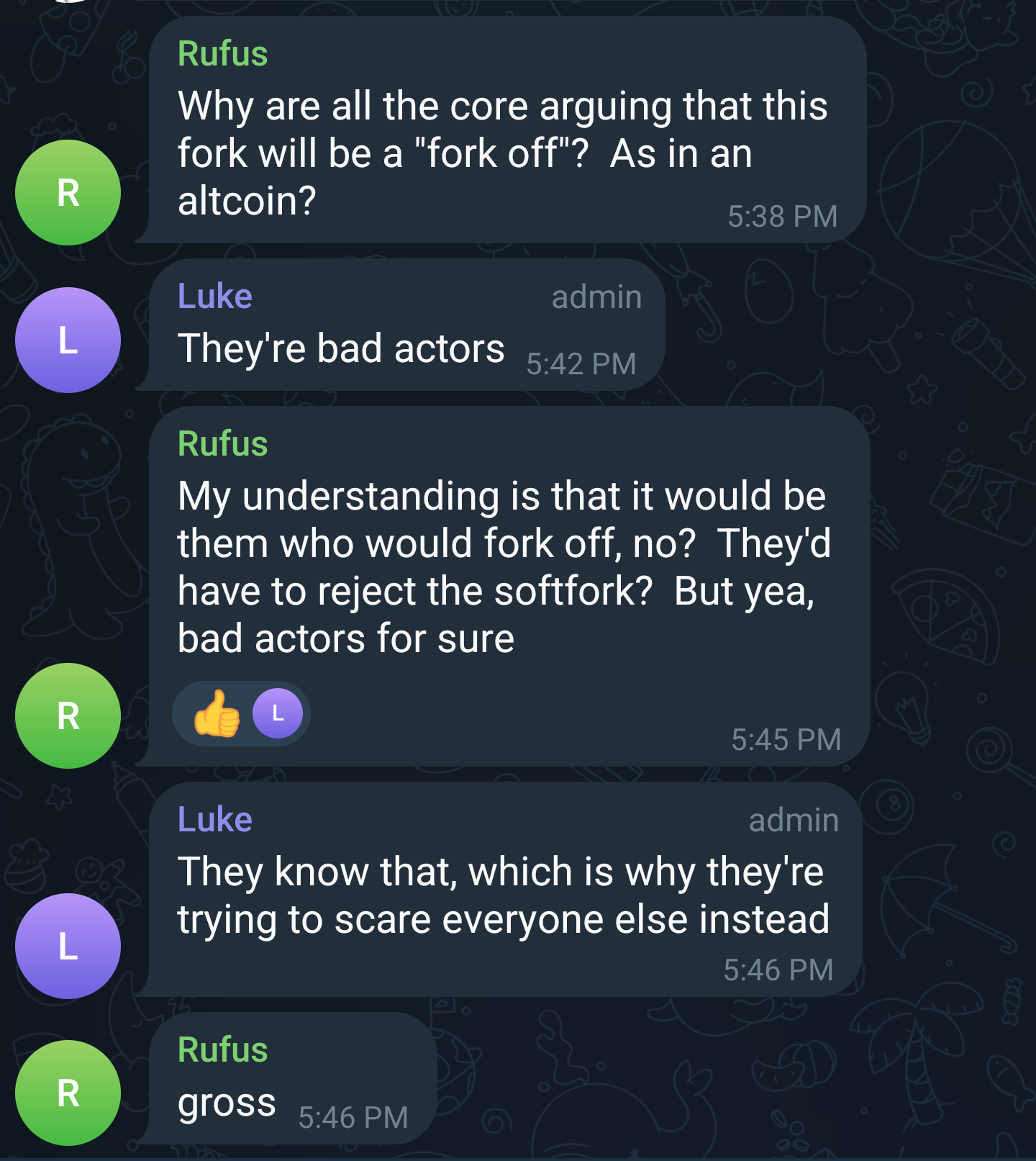
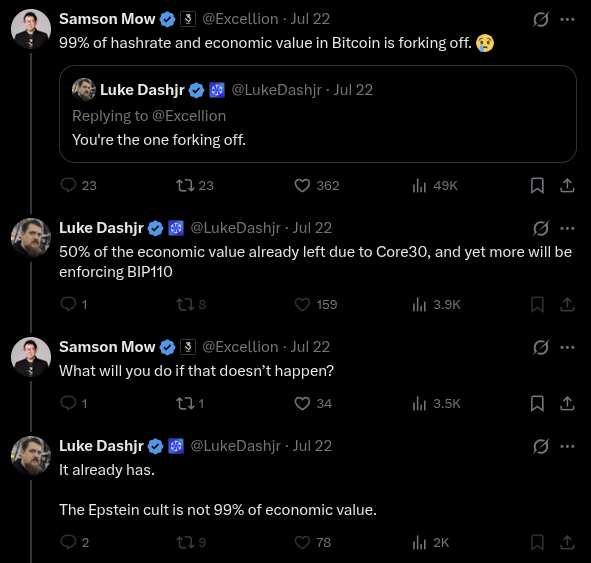
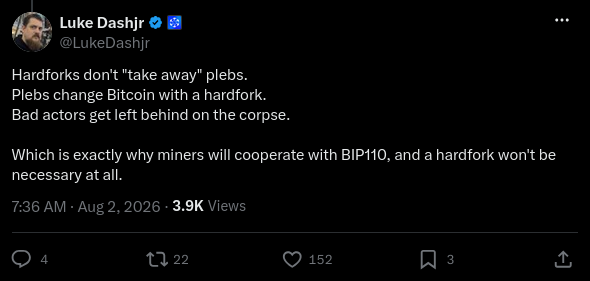
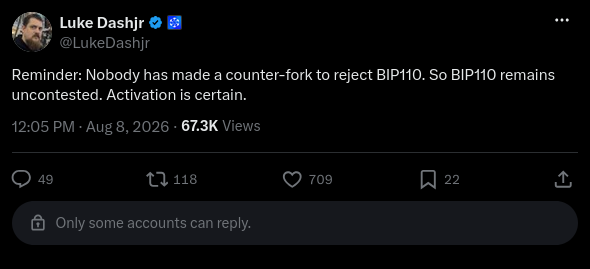
Bitcoin Mechanic Statements
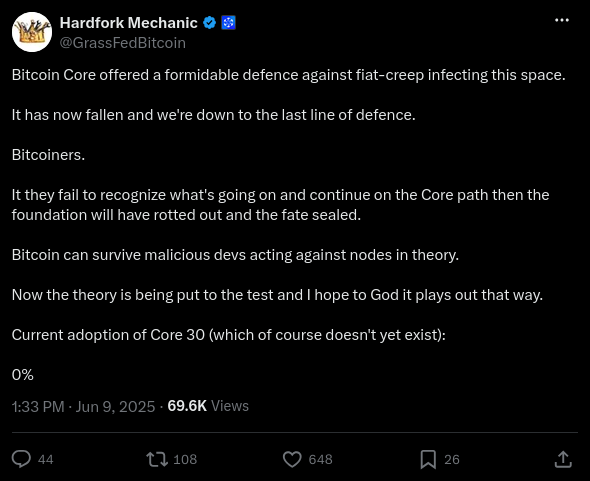
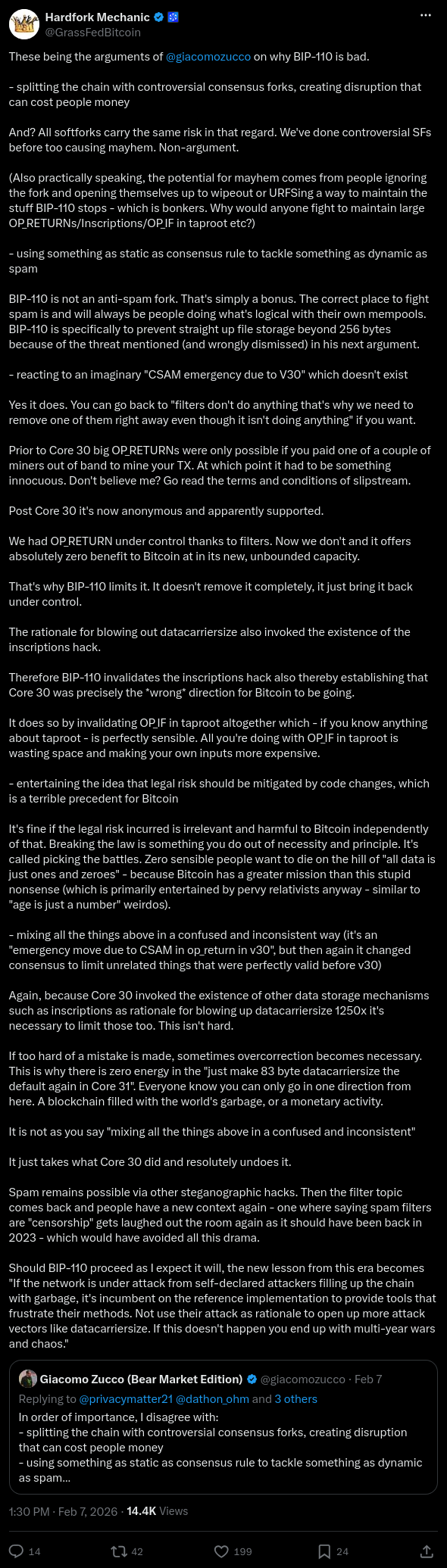

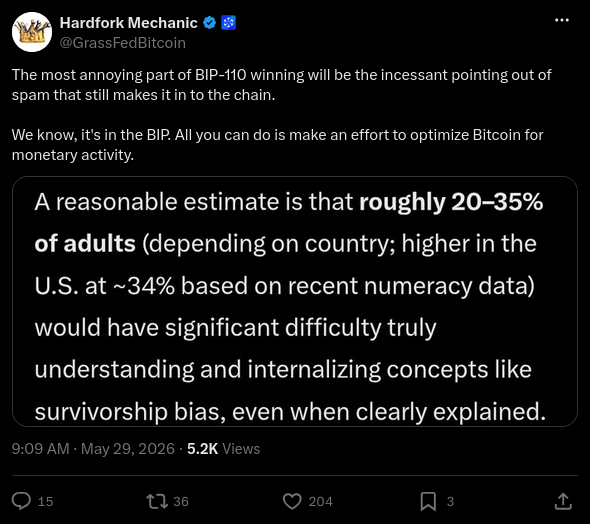
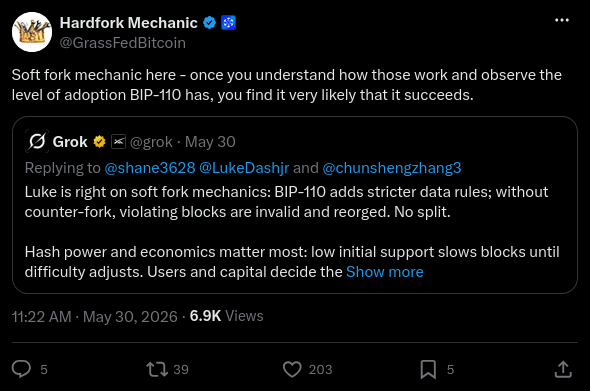
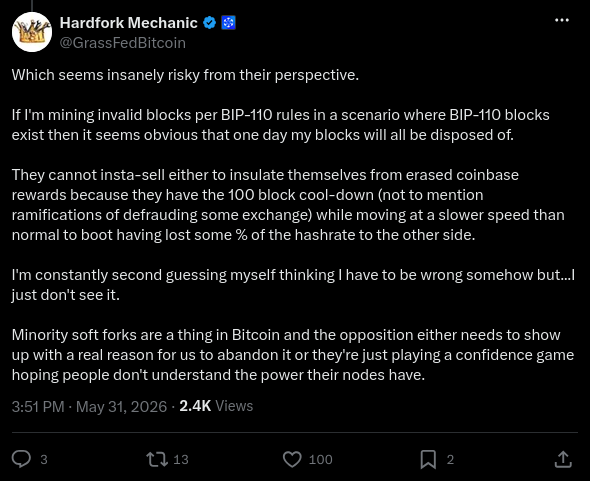
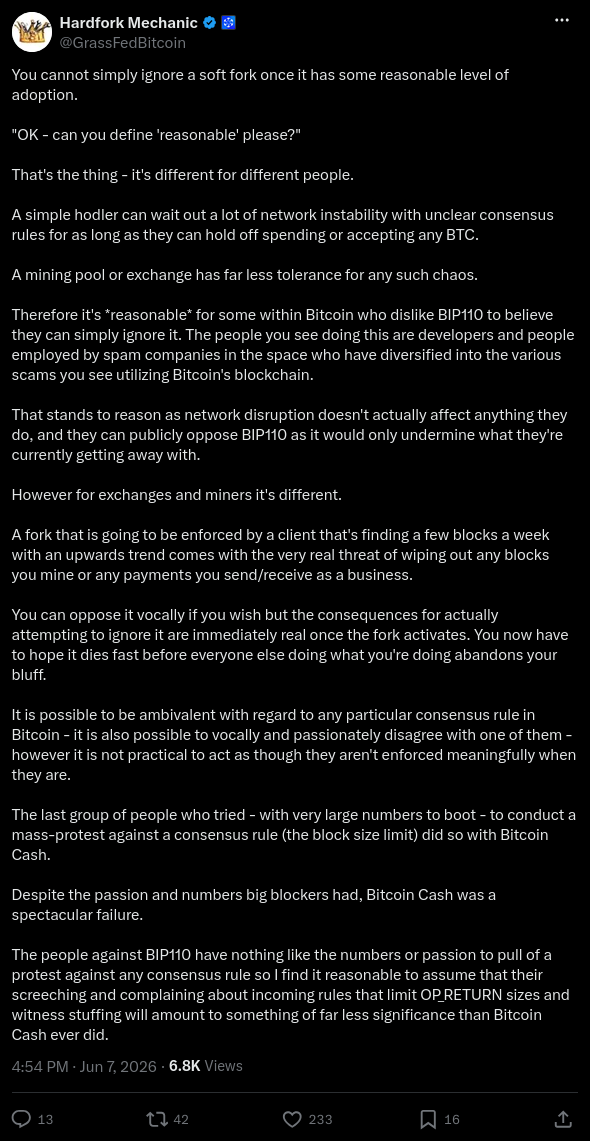
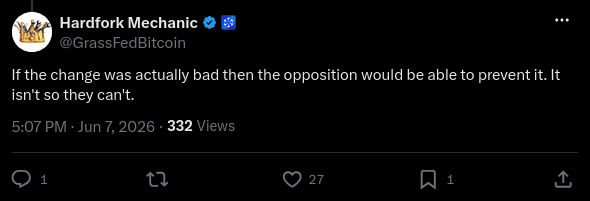

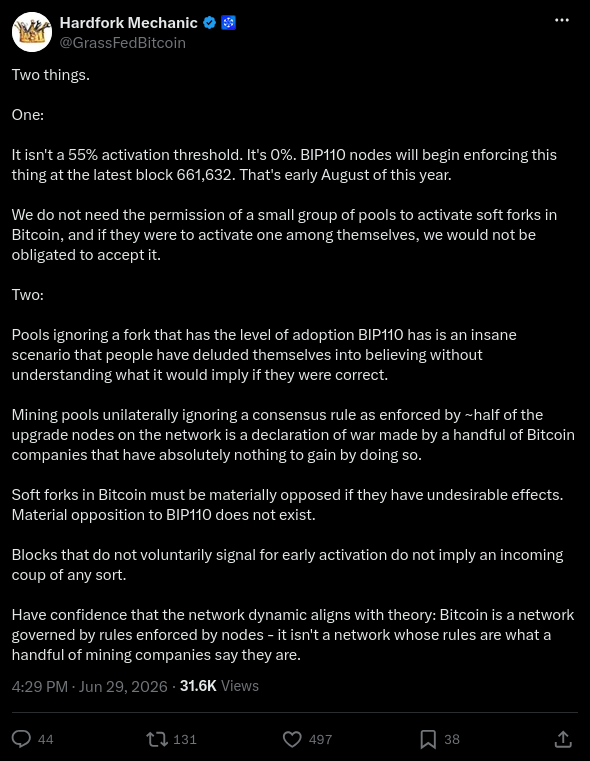

"Don't go to war with psychopaths like me" - hey buddy, you said it, not me!
I must say that it's pretty baffling that this guy, who was head of communications at OCEAN, thought it was a GOOD IDEA to portray his movement as suicide bombers!
Matthew Kratter Statements
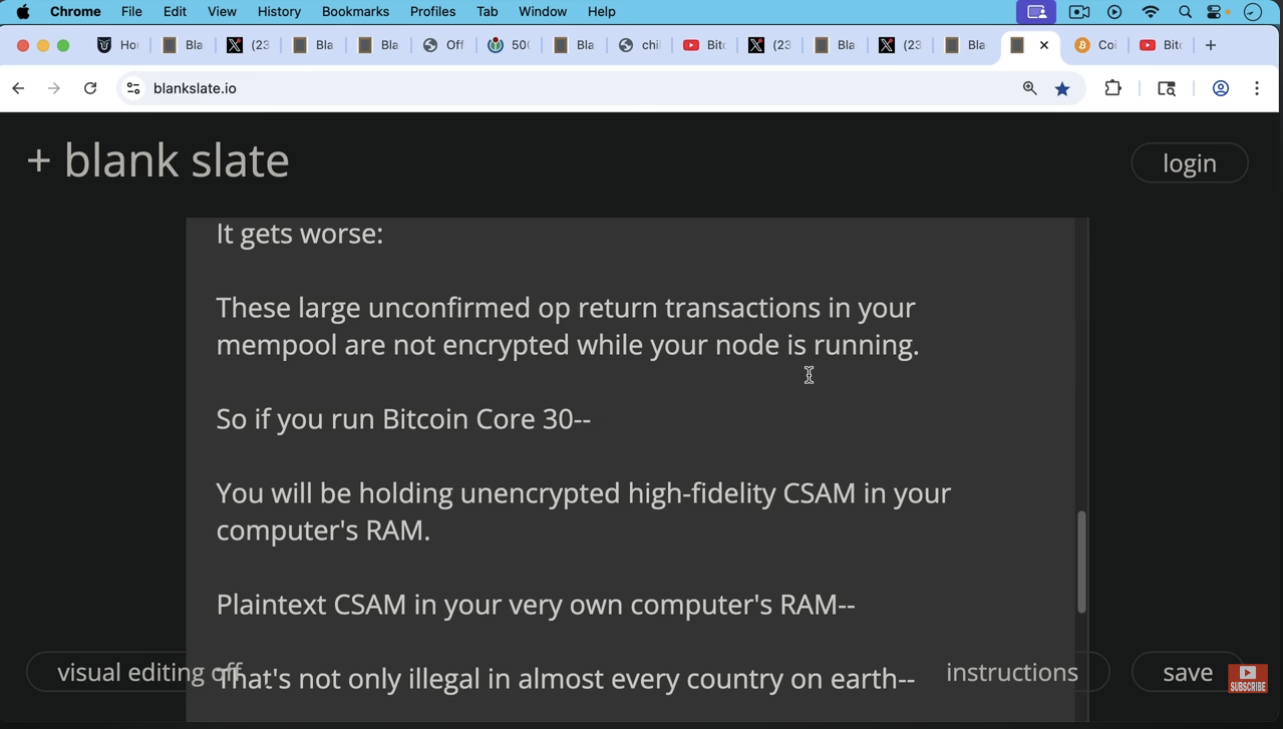
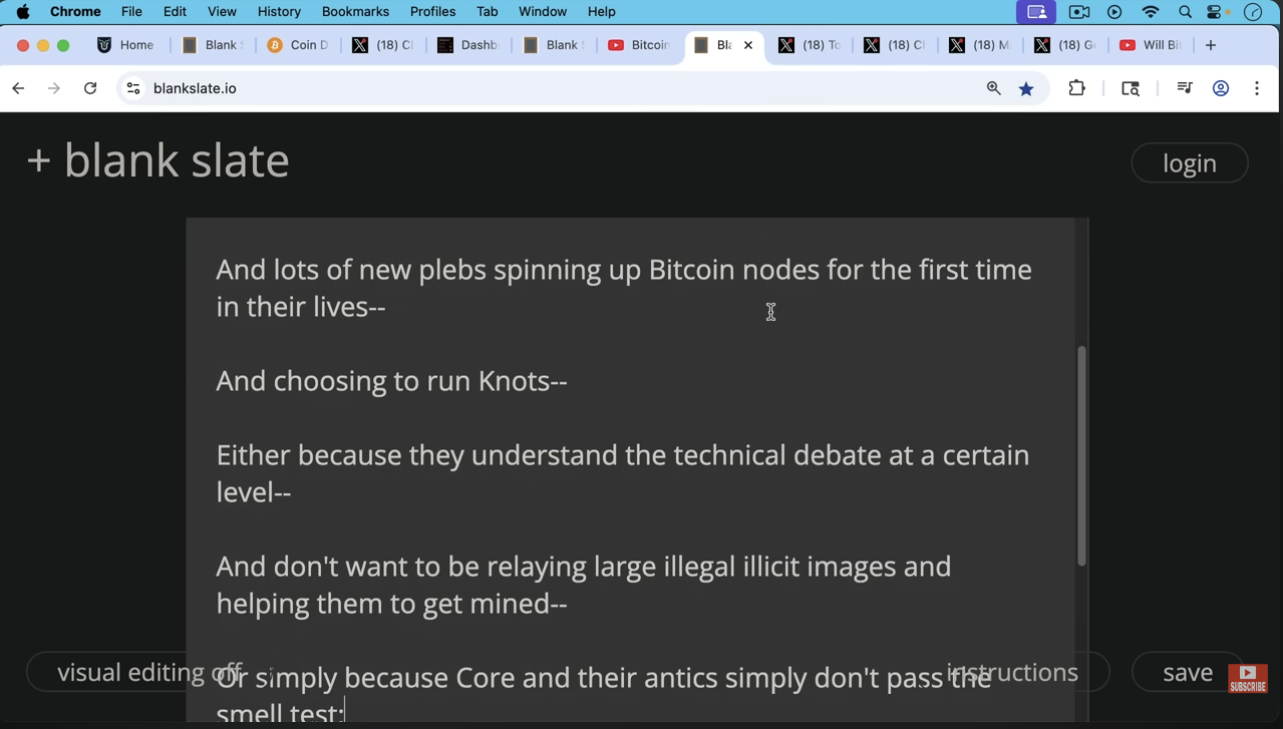
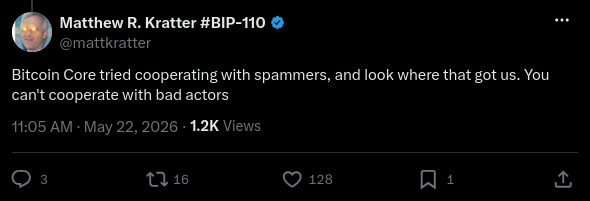
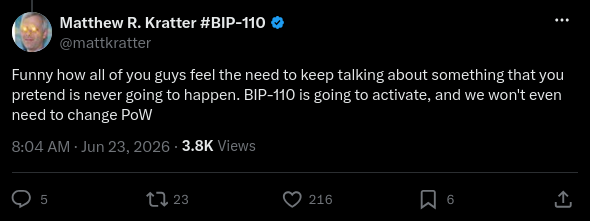
“We’re basically insane people” - you said it, not me! And some amusing threats aimed at miners here:
"We're just crazy enough to blow ourselves up!" As we can see, Mechanic's suicide bomber metaphor was a smashing success!
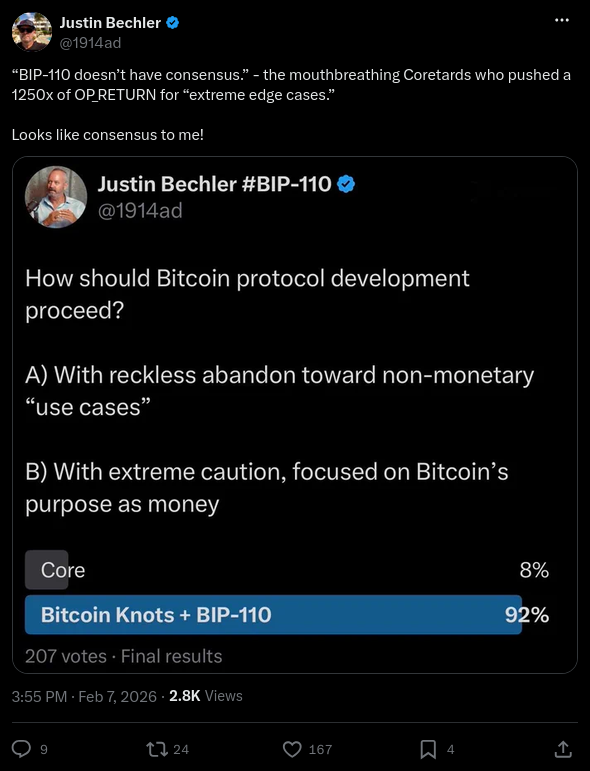
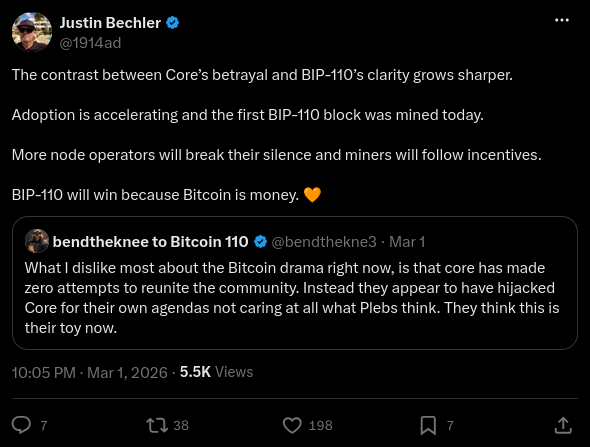
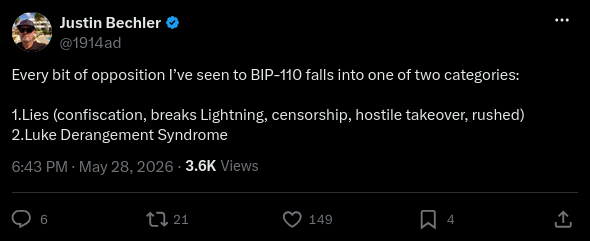
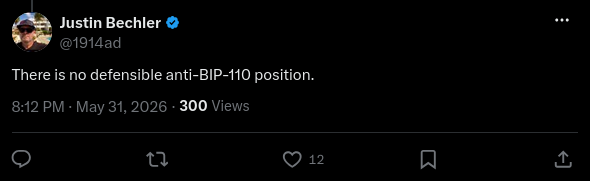
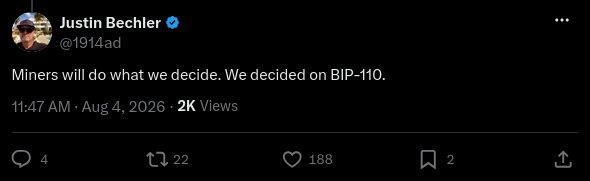
Justin Bechler
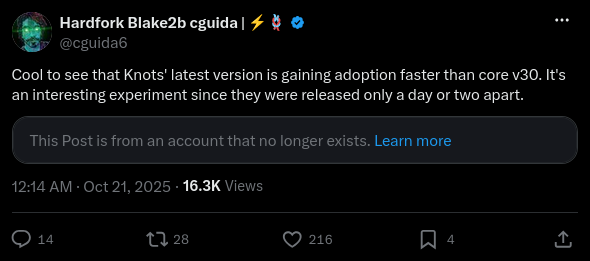
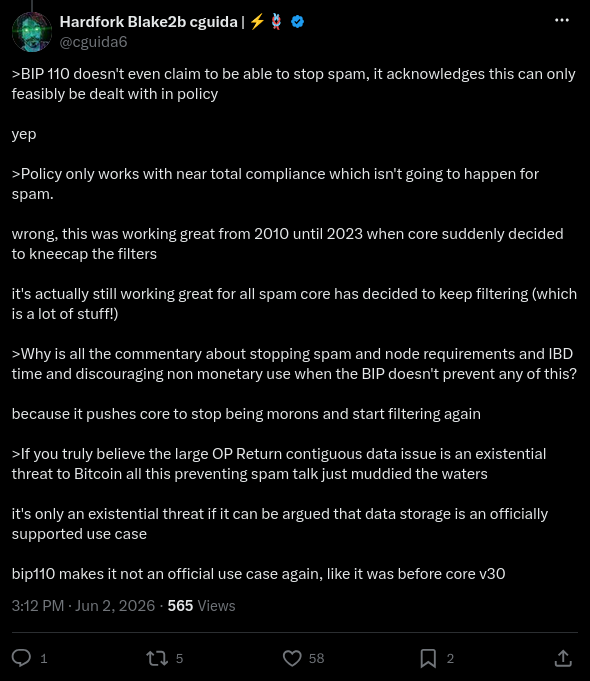
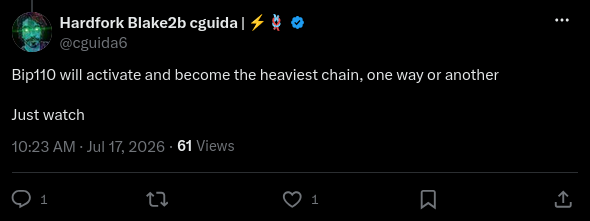
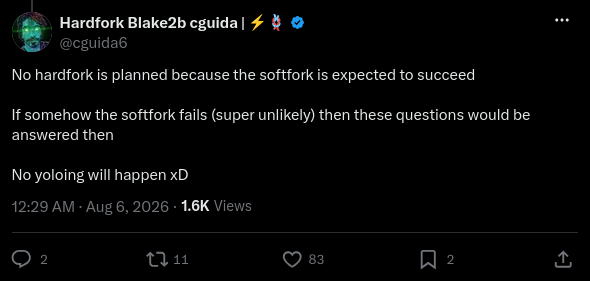
Chris Guida
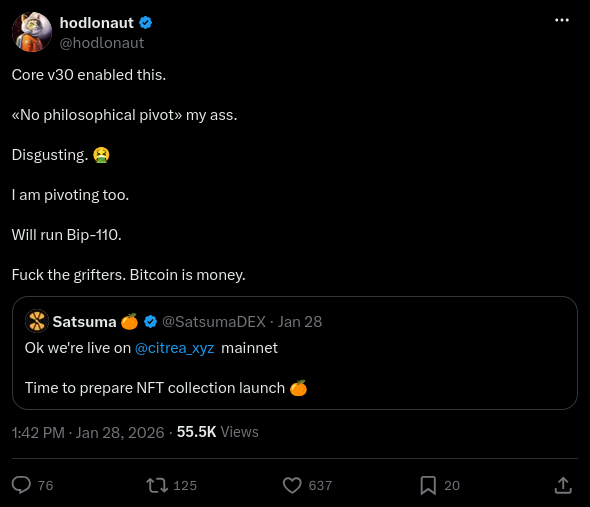
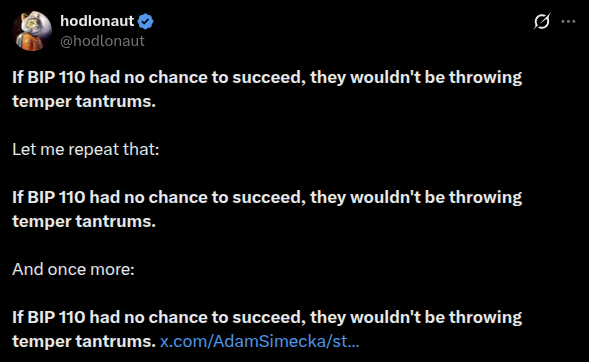
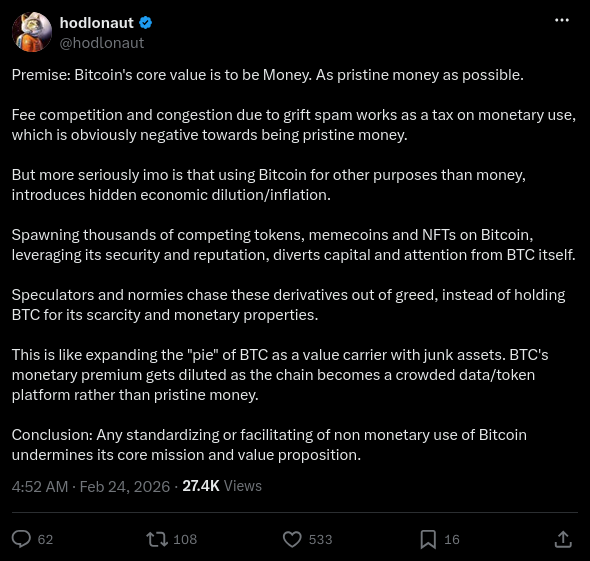
Hodlonaut
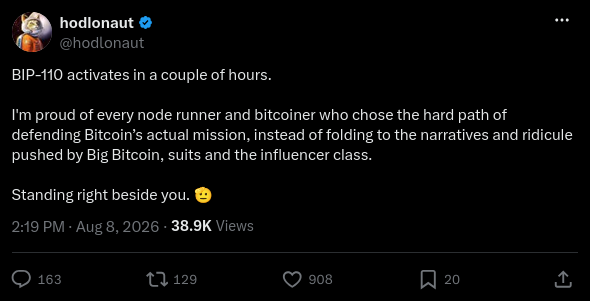
Overconfidence Errata
As you can see, I kept receipts. Many, many receipts. And these aren't one-offs, but are just an infinitesimal selection of the delusional slop that has been propagated on X all year.
It was unpopular because it was delusional.
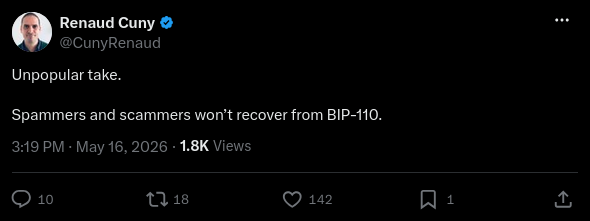
The inverse of what the rest of us were seeing...
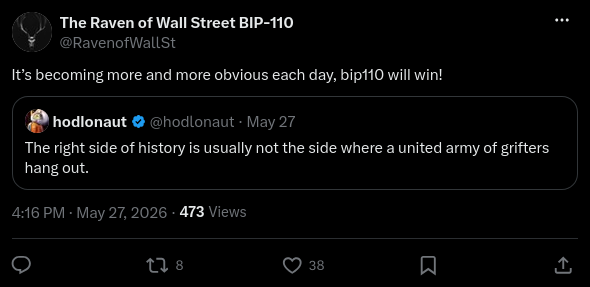
Narrator: "it wasn't true."
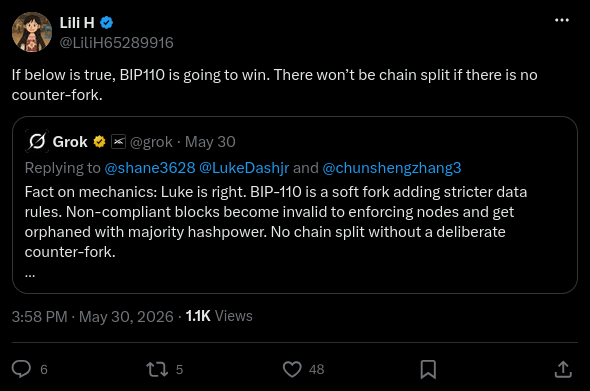
Bookmarked and screenshotted.
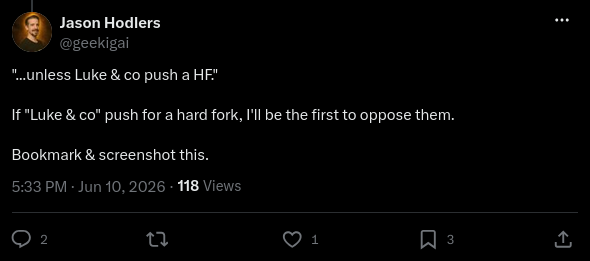
No tears shed.
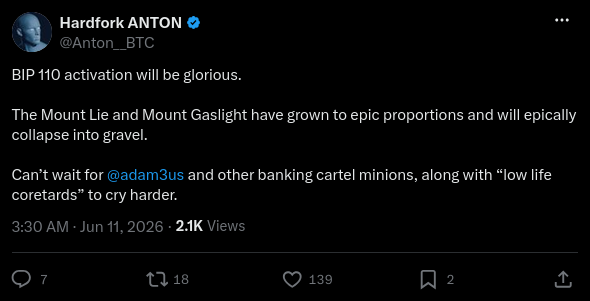
Can't wait to see how many more of these fail to hold up...
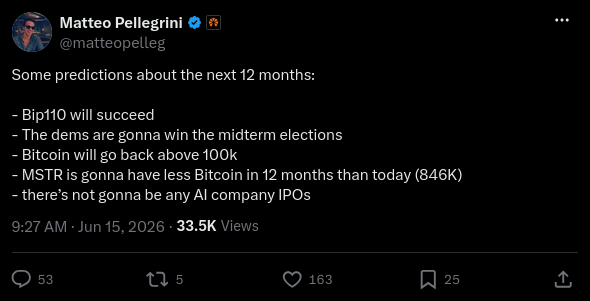
I haven't launched a DataSpamCoin and yet...
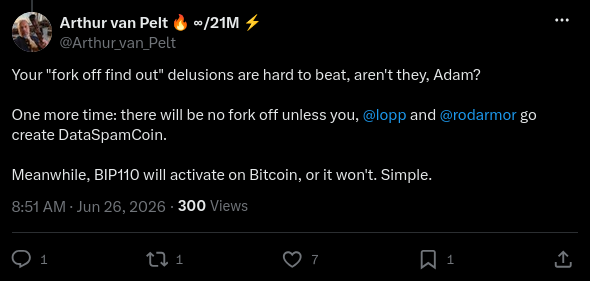
Possibility is only limited by one's imagination!
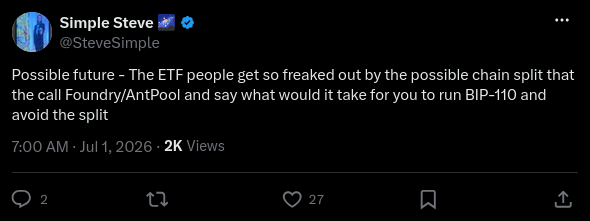
Oh no!
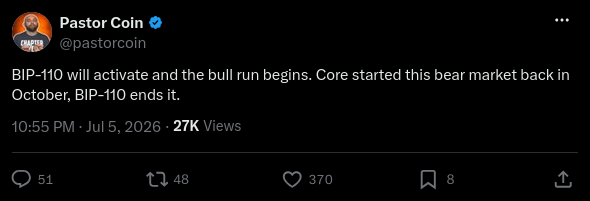
I'm underwhelmed.
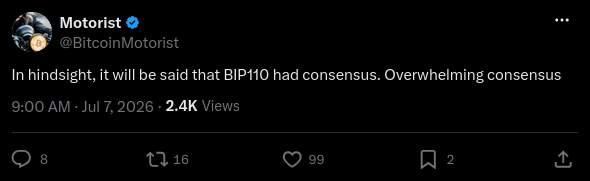
I certainly would have been confused if that had transpired.
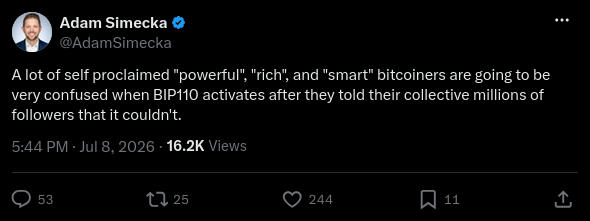
I guess the Bitcoin Groundhog says 6 more weeks of winter.
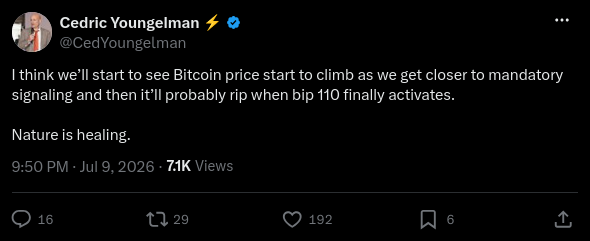
These folks are really bad at game theory.
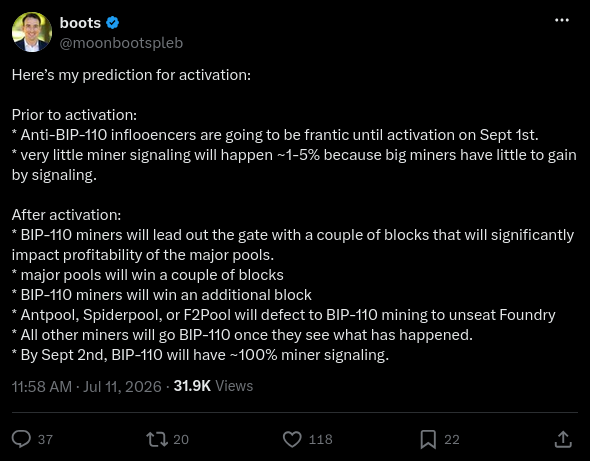
Um.... not? Let's go with not.
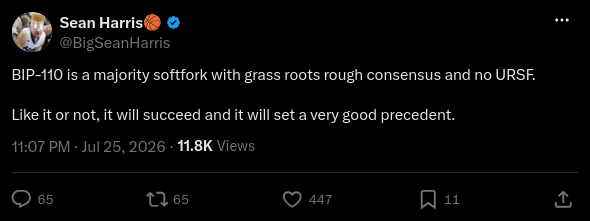
The only thing I scraped was X: to find the cream of the delulu crop.
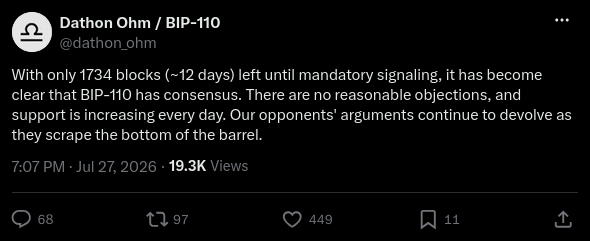
Well, this one was half correct!
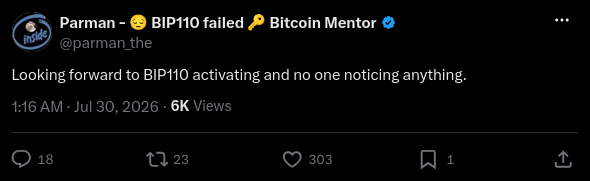
What Actually Happened?
Miner signaling maxed out at 2.5%
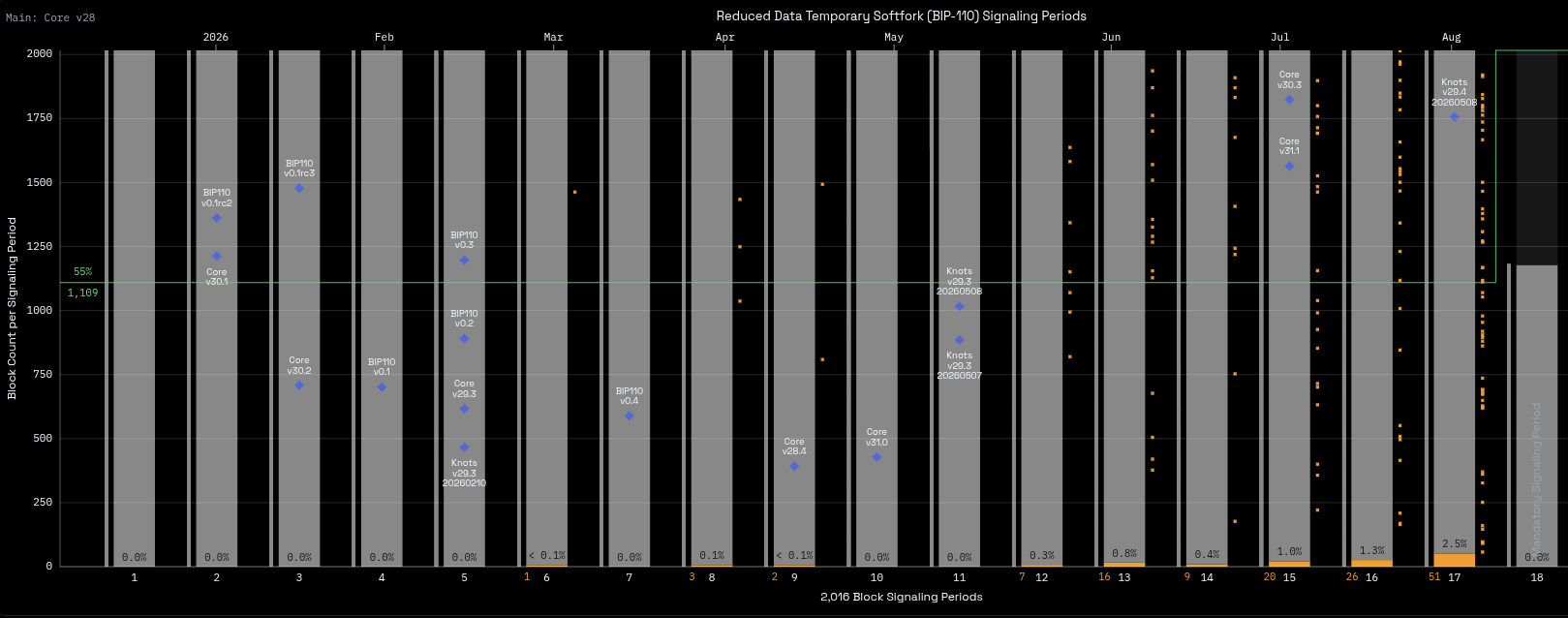
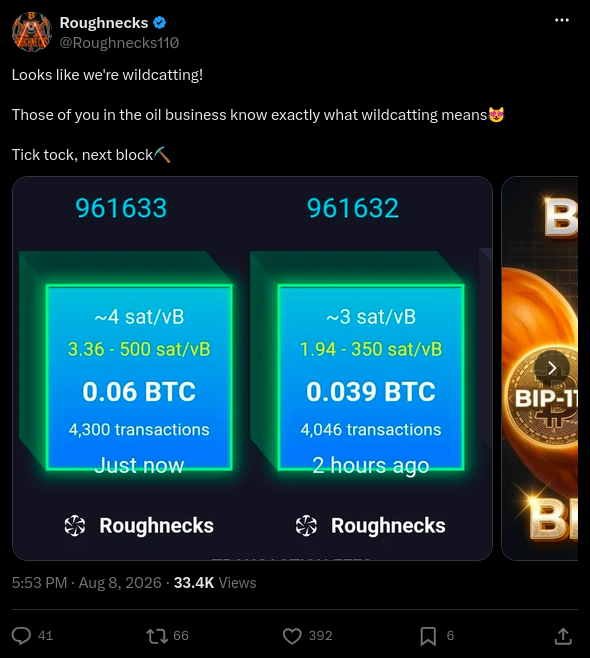
The BIP-110 chain fork managed to extend by 2 entire blocks before the die-hard anonymous miners calling themselves “Roughnecks” were forced to bend the knee to economic reality and stop lighting their money on fire.
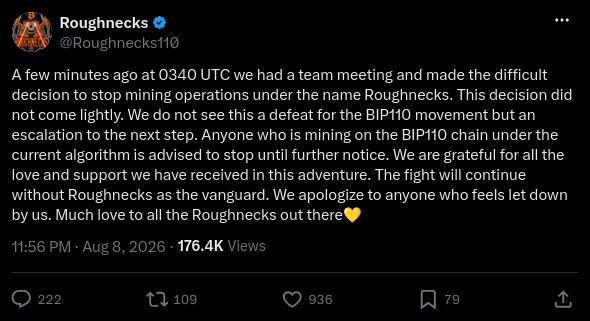
Oddly enough, Roughnecks came back the next day and decided to light more of their money on fire, eventually minting another 2 blocks before throwing in the towel for good.
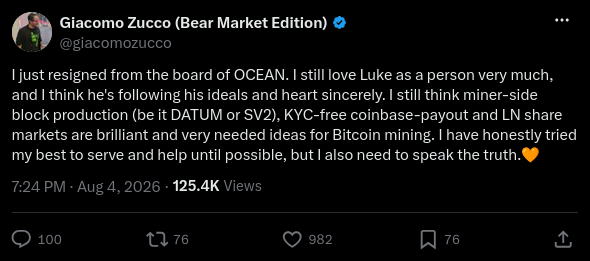
OCEAN ended up refunding miners who had their hashrate redirected toward the 110 chain.
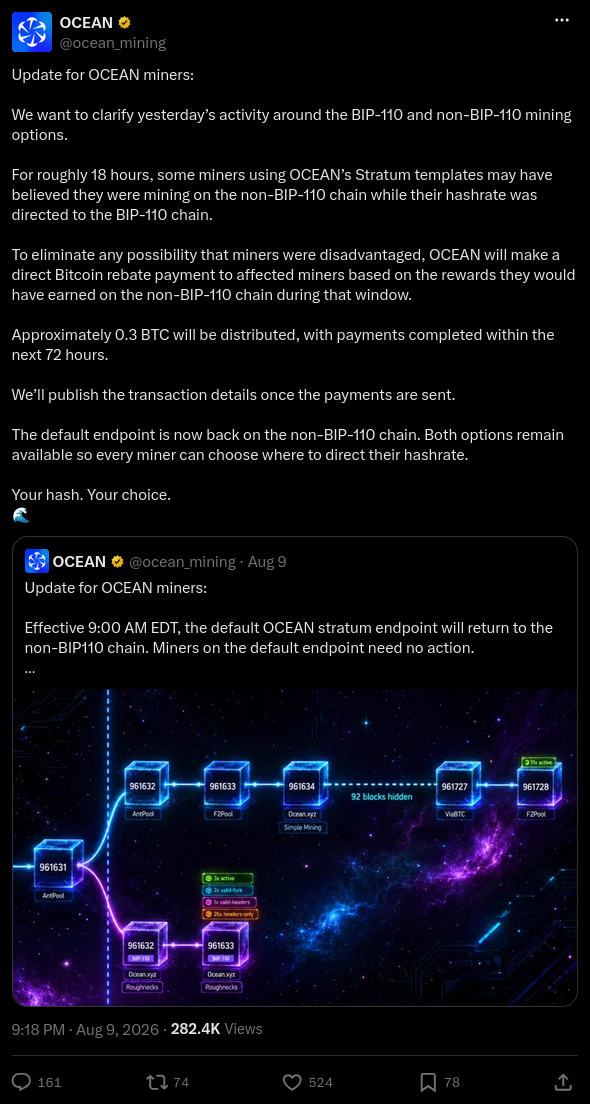
And as expected, now that the soft fork failed, the Puritan movement finds itself fracturing even further as the most hardcore Luke adherents follow him onto an irrelevant hard fork while the saner folks come running back to the real Bitcoin.
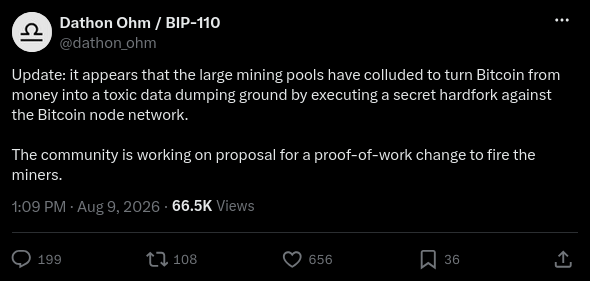
My Next Predictions
The coping and crying will continue by everyone who staked their reputation on this fiasco, regardless of if they choose to follow the hard fork or come crawling back to Bitcoin.
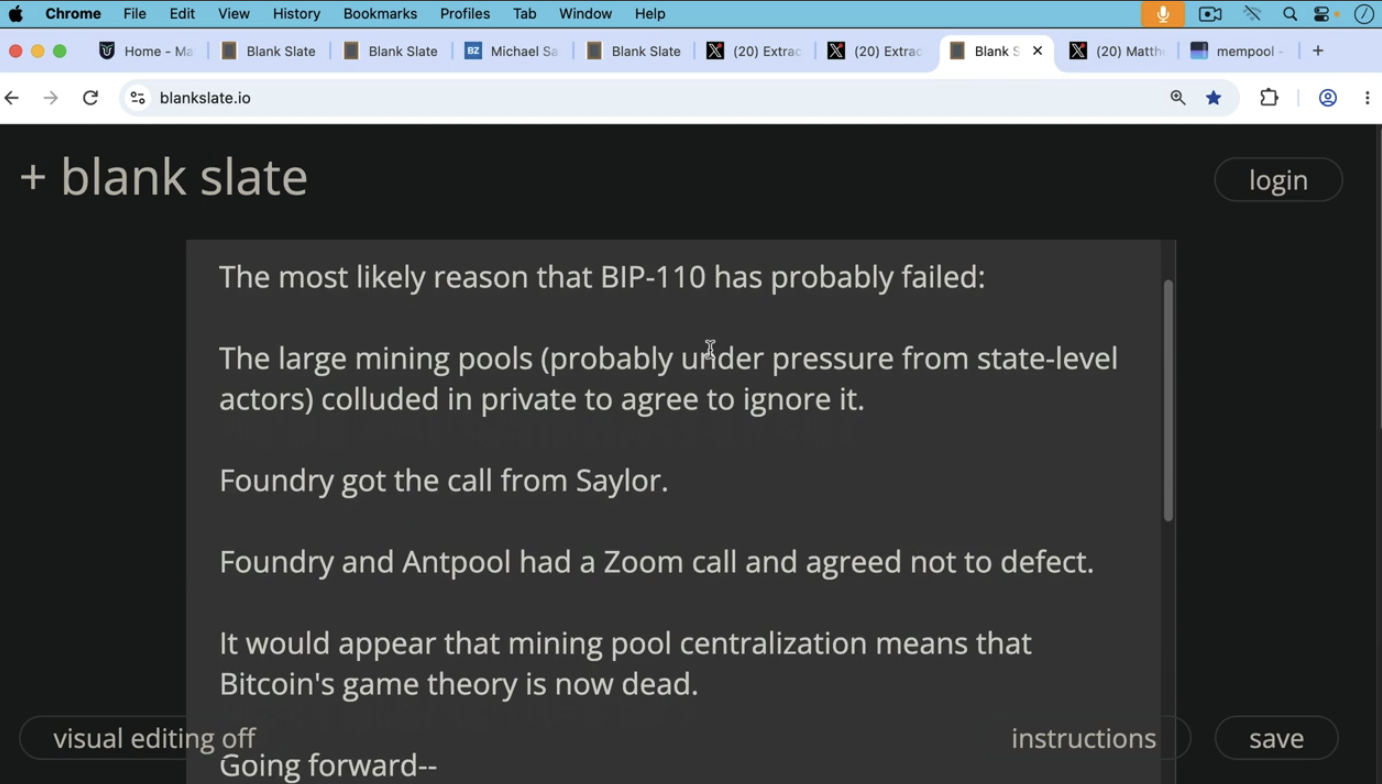
This is another common theme from failed forks: the failure is never the fault of the forkers, but rather due to conspiracies that didn't "fight fair."
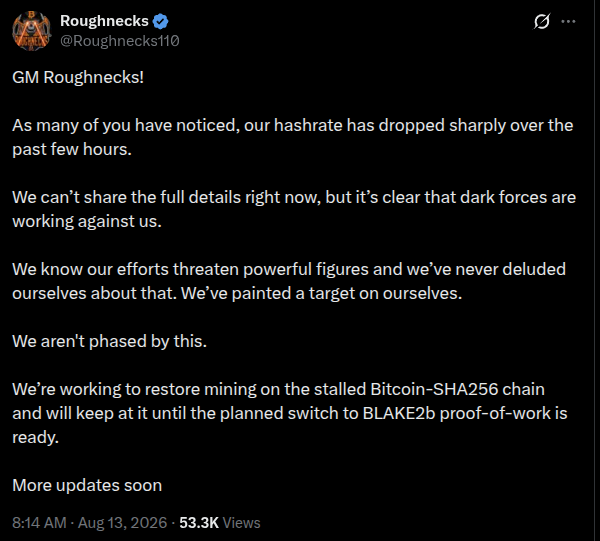
Puritans won’t stop until they’re on a network that bans everything they detest. They’re going to find out the hard way that our warnings were accurate: I can pretty much guarantee that whatever new network they launch, it’s going to have plenty of arbitrary data encoded into it for no reason other than to troll these block space Karens.
I expect the most devout of the Puritans will sell off their bitcoin (Luke said he already has, others like Kratter say they expect to) and will discover it to be an awful financial decision, just as those who sold their bitcoin for BCH or BSV.
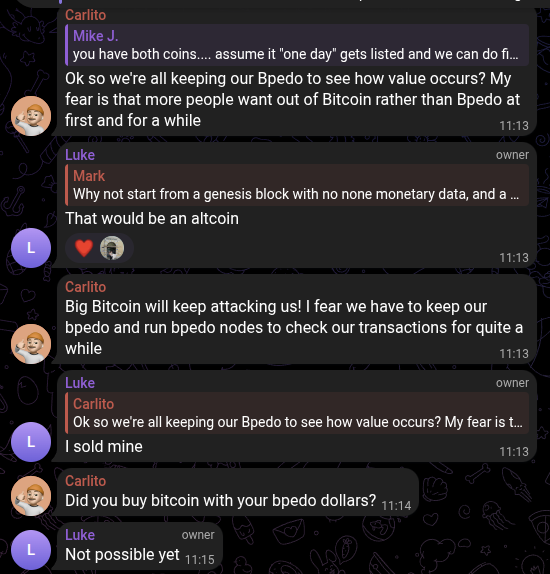
I expect that Bcashjr will fail to surpass even BSV in terms of exchange rate and adoption.
I highly doubt that Bcashjr will get listed on any exchanges of significant size; exchanges don’t list coins unless they either expect decent trading volume (there is no buy-side demand for a Puritan Bitcoin fork) or they get a large payoff for listing (Puritans won’t be willing or able to do this.)
Final Takeaways
Listen up Puritans, we get it. You don’t like seeing people using Bitcoin for stupid things. Welcome to the party, pal. I suspect it’s safe to assume that almost everyone who cares about Bitcoin doesn’t like seeing stupid stuff encoded into the world's most secure permanent record. But ultimately this is a case of whether or not one allows themselves to get upset by it. If someone does something you disagree with, are you going to carry on with your life or are you going to go full Karen on them devote your life to trying to stop them from behaving in a certain way?
Almost everyone agrees that this is not a war worth fighting because it's asymmetrically advantaged in favor of folks who want to encode arbitrary data into the blockchain. You can't make us fight a war we don't want to fight. On the flip side, we can't stop you from fighting a holy war you want to fight. Have fun with your obsession. Leave us out of it.
While this drama was going on, California attorney Asaf Fulks published a new project that aims to be a legal and technical framework for Bitcoin protocol governance with regard to consensus change standards. It's interesting to see how various consensus change proposals compare under his framework; his metrics made it quite easy to see why BIP-110 did not meet the bar.
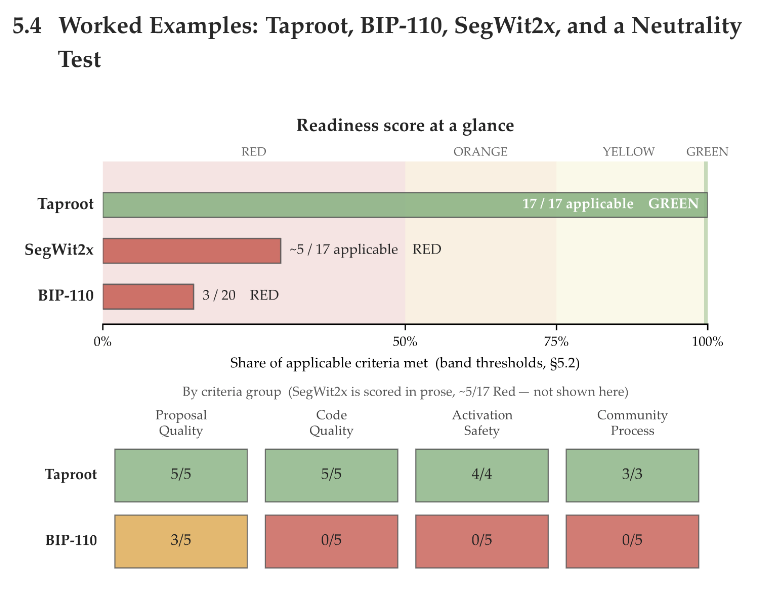
What should be some of the takeaways from this failed fork? Basically, all of the claims I and others were making regarding game theory and network dynamics that have now been shown to be correct. The false narratives propagated by delusional puritans should be thrown into the dust bin.
No, Matt Hill, you can’t bluff your way into a soft fork.
No, a User Activated Soft Fork with low overall support does NOT require a URSF (User Rejected Soft Fork) in order to stop it from succeeding.
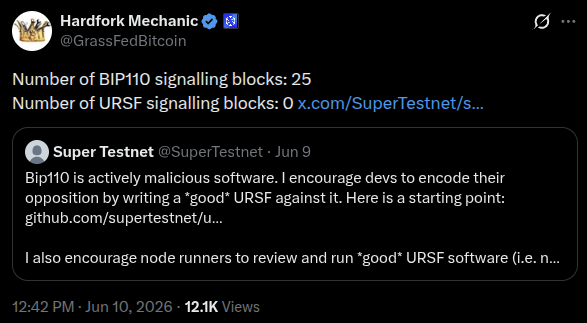
We learned that a UASF requires more than a tiny vocal minority of support to succeed.
We learned that calling anyone who disagrees with you a pedophile / CSAM apologist / Epstein associate is not a great strategy for building consensus.
We also finally learned the answer to the question I posed to Luke and Mechanic last year when they refused to admit they were working on a consensus change proposal - they ended up announcing it 2 days after this panel!
Congratulations, Bitcoin Puritans! You spent years whining on social media, X spaces, and podcasts. You spent a year whining on conference panels. What did you get for your efforts?
In a delightfully ironic twist, you managed to produce a worthless shitcoin.
Tip of the hat to Coinjoined!