The Last Untracked Generation
The Lost Art of Waiting, Wandering, and Being Unreachable
I've been thinking a lot lately about "the good old days" - not in the sentimental way, not with the idea that everything was better, but in the sense that every generation loses a few ordinary pleasures that were once so common nobody thought to protect them.
I suspect my generation, Millennials, experienced one of the sharpest breaks. Our childhoods still had one foot firmly in the analog world, while our children find themselves tethered to digital networks.
Before the internet, before smartphones, before everyone was reachable and everything was available on demand, the world ran on two things technology has quietly deleted: anticipation and unreachability.
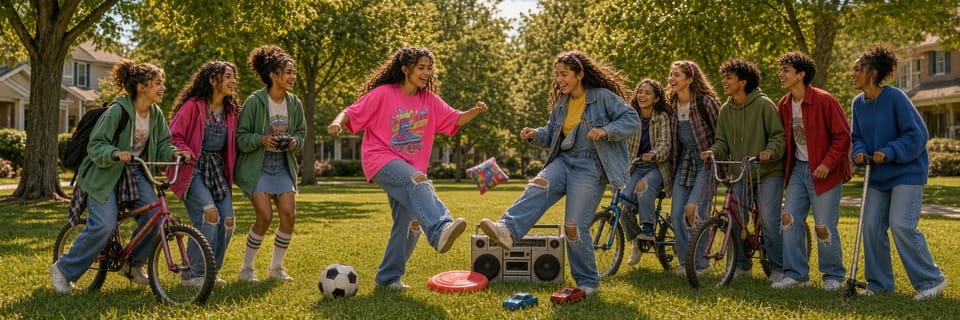
Many of the things we've lost used to require waiting, luck, or the simple fact that no one could find you. The '80s and '90s were mostly made of gaps - the space between wanting something and getting it - and kids filled those gaps with whatever was around: imagination, boredom, a bike, a friend, a quarter, a pencil.
What follows is a nostalgic inventory of lost pleasures and character-building frustrations: the small waits, small risks, and small mysteries that helped shape us.
A Childhood Without a Permanent Record
Before the rise of networked technologies you had no digital footprint. Your childhood was not documented, uploaded, indexed, and searchable. You were a kid, and that was the whole record.
If you did something dumb at fourteen, it didn't follow you forever. It became a story, maybe a joke, maybe a lesson, and then it faded. That was a gift, and we didn't know how good we had it.
There were no camera phones. No one filmed your worst moment. No one posted your bad haircut, your fall, your mistake, or the time someone picked on you in front of everyone. It happened, and then it was gone.
There was no permanent record, even though adults warned us there was one. You could start over. You could move on. The past did not have a search function.
You were also untracked. You left the house and you were simply gone. Nobody watched your dot crawl across a map. You were a free-range child, trusted to roam and expected to come home.
Your milestones were often unrecorded, too. Your first goal, your first fall, your first anything may have happened with only one person watching - or no one at all. You didn't need an audience. You just did it.
That privacy changed the texture of childhood. You didn't perform your life. You lived it. There was no feed, no audience, no metric. You were just a person: unbranded, unwatched, free.
Even mischief benefited from the lack of documentation. Ding-dong-ditch, toilet-papering a house, stuffing a mailbox - the prank was anonymous. There was no footage. There was only the story the next day, and possibly the beginning of a legend.
Urban legends spread by word of mouth. The alligator in the sewer. The vanishing hitchhiker. The hook on the car door. The babysitter and the man upstairs. You heard it from a friend of a friend, and you believed it completely.
This was before fact-checking became a reflex. Stories grew every time they were told. Nobody rushed to verify the legend. You let it be a legend.
Schoolyard rumors worked the same way. “You can unlock a secret character if you…” Half of it was a lie. You tried all of it anyway. The lie was part of the fun.
The Phone Was a Gate, Not a Leash
The landline was less a convenience than a social obstacle course.
Being genuinely unfindable was the big one. You left the house and no one could contact you. Period. Now a parent can watch a dot move across a map, but back then, once you walked out the door, you were beyond reach.
Calling a friend meant talking to your friend's parent first. “Is Matt there?” was a mandatory social gauntlet. You had to perform politeness under mild interrogation before you ever got the person you actually wanted.
You memorized phone numbers because you had to. You knew a dozen by heart. Now you know maybe three, and one of them is your own.
Long distance used to be an event. Calling collect meant racing to say, “It's Bob, we're having a baby!” before the operator cut you off. Now long distance is free, and hardly anyone calls because even a phone call can feel like an imposition.
Even the busy signal had dignity. When you heard it, you knew something specific: someone was on the phone. That was information. Now a call can ring forever without telling you anything at all.
Household phones shared a line, which meant privacy was a negotiation. Your sister could be listening in on the other extension. You suspected she was there, but you couldn't prove it.
Then there was the cord. You stretched the coiled phone cord around the corner into your room, whispered so nobody could hear, and let the cord slowly strangle your freedom.
Three-way calling was a technological flex. You demoed it for friends like it was a magic trick. You recorded your answering machine greeting, then called your own house just to hear it back and critique your performance.
The payphone was its own little universe. A quarter. The number taped inside the booth. 1-800-COLLECT. The coin-return slot you checked every single time like it was a slot machine.
Phone cards had a PIN you memorized, a scratch-off silver strip, and the slow drain of minutes you could feel happening.
And then there was *69, with all the hope it carried. The mystery of who had just called you. The little jolt of calling them back.
The phone was not a pocket-sized surveillance device. It was a place you had to show up.
Porches, Neighbors, and the Block
The neighborhood used to be a social network with actual porches.
Door-to-door fundraising meant Girl Scout cookies and gift wrap arrived in the form of a kid on your porch holding a paper order form. Now it's often a QR code.
Knocking on someone's door to ask a question was normal. “Can Dave come out?” was a house call. You stood on the porch and waited. Now you text Dave.
Borrowing a cup of sugar meant asking someone whose last name you actually knew. These days, sugar can be delivered to your front door, and bothering a neighbor can feel almost rude.
Trick-or-treating used to be free-range. Full route. No parents. Knocking on strangers' doors. Judging every house by its porch light. Now it is often a Trunk-or-Treat in a parking lot, or a Ring camera watching a bowl of candy left unattended.
The porch light itself was a signal. On meant come in. Off meant it was late. A flicker meant somebody was mad.
Block parties didn't require much official machinery. The street closed off. The grills came out. The kids stayed up past dark. Somebody probably should have filed a permit, but nobody did.
The phone tree was the original group chat, except it required you to actually talk. News traveled person to person down a list, and being the person who forgot to call the next person was a serious failure.
The Living Room Was an Appointment
Entertainment used to require preparation, patience, and a little luck.
Friday night meant Blockbuster. You browsed the aisles, hoped the one new release was still in stock, and felt genuine horror at the sight of its empty box. “Be Kind, Rewind” was not ironic yet. Late fees were real.
Rewinding a VHS was a civic duty. If you were super nerdy you used a dedicated rewinder machine, which felt like the future.
Movies took a long time to arrive in stores. The theater was the only option for months, and the tape was the payoff you waited all year for.
Saturday morning cartoons were an appointment. Bowl of cereal. Still in pajamas. You woke up for them. You dare not miss them.
TV Guides were actual planning documents. Highlighting the week's schedule was how you prepared. Surfing with the clicker was the whole experience.
Television even ended. The sign-off came. The national anthem played. The test pattern appeared. Then static. TV used to sleep. Now it never does.
Rabbit ears and tinfoil were part of the ritual. Adjusting the antenna was a two-person job: one person twisting, the other yelling, “Better! No, worse! Hold it right there!”
If there was no remote, “you're closest to the TV” was family law.
Then came dial-up. The handshake screech. The phone line tied up. Someone yelling, “Get off the phone, I'm online!” One song took forty minutes to download, and you loved it anyway.
AIM away messages were tiny public mood rings. MSN had its nudges. GeoCities pages had MIDI music and hit counters. The door-opening sound of someone signing on to AIM meant your crush was home.
Sometimes you taped a movie onto a VHS and later discovered it had overwritten someone's wedding. Tragedy. You kept the movie anyway.
Music Had to Be Earned
Recording a song off the radio was a performance. Finger on pause. Heart pounding. Waiting for the song to start. Then the DJ talked over the intro and you lost your mind.
Waiting for your favorite video on MTV worked the same way. You knew it played at a certain time, so you sat there and watched the six videos before it. That was the price.
The record store had listening booths. You put on the headphones, flipped through CDs you couldn't afford, and decided your whole identity in fifteen minutes.
Sometimes you bought an entire album for one song. You paid $16.99 for track four and hoped the rest was good. Sometimes it was. That's how you discovered more music.
Liner notes were scripture. Who played what. Who wrote what. Thank-yous to people you'd never hear of. The booklet was part of the album.
The record store clerk was a gatekeeper. You asked what was good, and you trusted the answer. There was no algorithm - just a dude with opinions and a ponytail.
The mixtape was a love letter. You sequenced it so the feelings built. You timed the fades. You recorded it in real time and held your breath between tracks. You gave someone hours of your attention, on tape.
The Walkman was freedom, with limitations. One cassette. Auto-reverse. A pencil to rewind it when the batteries died. Your whole music library lived in a shoebox at home, and three songs lived in your pocket.
The Discman promised protection with its little anti-skip button. It mostly lied.
Sometimes you didn't know who sang a song. You hummed it to a friend. You waited for the DJ to say it. There was no Shazam - just patience and a half-remembered lyric.
The radio request line still had magic. You called the station, asked for a song, and maybe - maybe - hear your name on the air. Now you can request whatever you want with a click, and nobody says your name.
Concerts were spoiler-free. You didn't know the setlist. You didn't know the encore. You just found out, live, in the dark.
Music was not a utility. It was a pursuit.
The Mall, Arcade, and Unstructured Afternoons
The mall used to be a destination, not an errand.
You went there with no plan and no reason, and that was the whole point. You walked in circles for three hours and called it a good time.
The food court was a social ecosystem. Where you sat was who you were. The politics of it were real and unwritten.
You could browse without buying. An entire afternoon in a record store, a comic shop, a bookstore, and nobody bothered you. Loitering was a lifestyle.
The no-phone mall had its own electricity. You met people by being there. You ran into your crush by luck. The whole thing was untracked and unrehearsed.
Video games had their own rituals.
Cheat codes came from magazines and schoolyard rumors. Somebody's cousin knew how to unlock a character. Half of it was a lie. You tried all of it anyway.
Some early console games made you beat them in one sitting. Few could save your progress. You got three lives, and then it was over.
The battery save was fragile. Your Zelda file could vanish because the little battery inside the cartridge gave out. There was no cloud. There was only the battery, and it was mortal.
Nintendo Power arrived in the mail like a sacred text. Strategy guides. Tips. A 900 hotline number your parents definitely did not want you calling.
Renting a game often meant renting a game with no manual. The manual was always lost. You figured it out by mashing buttons and asking a friend.
Split-screen couch multiplayer was personal. Two controllers. One TV. No headsets. No strangers online. Your rival was sitting next to you, and you could elbow them.
Sleepovers were the peak of human civilization. GoldenEye. Mario Kart. Three in the morning. Someone asleep on the floor.
LAN parties meant hauling an impossibly heavy desktop tower and CRT monitor to a friend's basement so you could play together over a local network. It was “online” before online was easy.
Blowing into a cartridge didn't really work. You did it anyway. It was a ritual.
Sometimes renting a game meant inheriting a stranger's save file. You lived in their progress for a while.
The arcade was an actual destination with actual quarters. You watched the best player over their shoulder like it was a museum exhibit.
The high score board offered three letters of immortality. AAA. ASS. And one guy who was clearly trying too hard.
Putting your quarter on the cabinet claimed the next game. It was an honor system enforced by everyone.
Outside Until the Streetlights Came On
The outdoors used to be the default world.
You played outside until the streetlights came on. The streetlight was the only curfew enforcement mechanism, and it never lied.
Sometimes the plan was no plan. “Just go to the park and see who's there.” Plans formed by physically showing up. No group chat. No RSVP. You went, and whoever was there was there.
Your bike had no lock, no tracker, and often no helmet. You left it in the yard. You rode it into the woods. You came back with a scraped knee and a story.
Manhunt and flashlight tag happened across entire neighborhoods after dark. The dark was allowed. The dark was the game.
Bike ramps and forts were built from scrap lumber and pure optimism. Somebody's dad had a hammer, and that was all the engineering required.
Street baseball had its own universal rule: “CAR!” The whole game froze. Everyone stood still. The car passed. Play resumed.
Kick the can, sardines, ghost in the graveyard, sharks and minnows, red rover, four square, mother may I - these games needed nothing but kids and enthusiasm.
The Slip 'N Slide, the sprinkler, the running-through of it all. Nobody re-applied sunscreen. Nobody tracked screen time. You were just wet and outside.
You caught toads. You caught crawdads. You built dams in the creek. The creek was a place you went, not a thing you read about.
The rope swing over the swimming hole had no inspection. No insurance. You swung because everyone else had swung, and that was all the safety check it needed.
Sports were slower, too.
You waited for the score in the morning paper. The game ended at eleven, but you didn't know who won until breakfast. You unfolded the sports page and read it like the news it was.
SportsCenter was an appointment. You sat down to watch the highlights. No phone. No app. Just the desk, the plays, and the anchors.
A transistor radio under the pillow let you listen to the game in the dark. You imagined every pitch because you couldn't see a thing.
The card shop had a glass case and a guy behind the counter who knew the value of every card and the joy of almost none.
You memorized starting lineups because you had to. There was no fantasy league, no stat overlay. You knew the roster because you cared.
And when you and your friend disagreed about whether someone was safe or out, there was no instant replay. You just argued. Forever.
Outside was not an activity. It was where life happened.
School, Mail, and the Slow Search for Answers
Schoolwork was slower and more physical.
Encyclopedia Britannica and the card catalog were the closest thing we had to the internet. Alphabetical order. Volume “A–Am.” Drawers sliding out. Little cards with call numbers.
Microfiche and microfilm readers came with a crank. You scrolled through old newspapers hunting for one article and called it research.
The overhead projector had its own smell. Mimeograph ditto sheets smelled incredible. That purple ink. You held the page up, and it was still wet.
Typing class happened on actual typewriters. A mistake meant white-out or starting over. You felt every error.
Writing a report meant going to the library. You pulled the books. You wrote it by hand or typed it. You liked it, or you learned to like it.
Book reports lived on index cards. Citations were formatted by hand from a dog-eared AP Stylebook.
Passing notes was an art. They were folded into tiny complicated shapes and delivered by relay. Now everyone texts under the desk, and the note is dead.
Blackboards came with chalk dust and clapping erasers outside. Cursive was taught because it was tradition. Penmanship class did not need a justification.
Information had weight. It had to be carried.
Mail had weight, too.
The mailbox was an event. You walked to the end of the drive and checked it. The anticipation of a package, a letter, or a catalog built for days.
The Sears Wish Book at Christmas was hundreds of pages of toys. You circled things. You dog-eared pages. You lived in that catalog for a month.
Sea-Monkeys, X-ray glasses, the little ads in the back of comic books - you sent in your dollar and waited a month for disappointing junk.
Proof-of-purchase points required faith. You saved the box tops, mailed them in, and waited six weeks for a prize that was never as good as you hoped.
Chain letters were psychological warfare. You copied it. You sent it to ten people. You broke the chain once, something mildly bad happened, and you never broke it again.
Choosing the stamp, writing the envelope, walking it to the mailbox - sending something meant doing something.
Packages were untracked. You mailed something and had faith. It showed up or it didn't. There was no little dot moving across a map.
Book and music clubs were subscription services before subscriptions were cool. The difference was the waiting.
Pen pals were like texting with a stranger, except you could send only one message a month. You wrote to a kid in another state or country and knew very little about them. That was the charm.
The world was not instantly available. You had to ask, wait, search, write, and hope.
Money, Collections, the Weight of Ownership
Money used to be physical, and work used to be local.
The paper route had a bag throw, Sunday collections, rubber bands, a list of names, and a sack of coins.
A summer job could be acquired by walking in and asking. No online application. Clean shirt. “Are you hiring?” Somebody said yes.
Odd job flyers lived on telephone poles. You tore off a little strip with the phone number. That was the whole listing.
There was no comparison shopping. You paid what the store charged. You didn't know it was cheaper elsewhere. That was fine.
Cash was king. Exact change mattered. You needed a wallet for bills and a coin purse for loose change.
The coin jar was a childhood financial institution. Carrying change was annoying, so you threw it in a jar when you got home. Eventually you rolled the coins by hand and took them to the bank. Coinstar machines felt like magic.
Collections had weight, too.
The shelf of tapes, CDs, and comics was yours. You could hold them, lend them, lose them. They were yours in a way a subscription will never be.
The baseball card binder. The wax pack. The rookie card. The one you kept in a sleeve and the one you put in your bike spokes.
The VHS collection. The tapes you recorded. The labels you wrote. The shelf that sagged under the weight of them.
The comic book long box. The smell of the paper. The corner store. The spinner rack. The dollar bin.
The mixtape drawer. The burned CD stack. The liner notes you kept. You owned the music, and owning it meant something.
The photo shoebox. The negatives. The albums. The physical proof of your life, in a box, in a closet, in your hands.
If you lost it, it was gone. That fragility made you take care of it.
Ownership was not abstract. It occupied physical space.
Road Trips and the Art of Getting Lost
The family road trip used to begin with paper.
The fold-out map was your GPS. You were the navigator, and you were bad at it. The map never folded back right. You were always one exit late.
The AAA TripTik arrived in the mail: a highlighted route, brochures, and a physical plan for the trip. If you missed a turn, there was no voice calmly rerouting you. You just argued about the map and kept driving.
Asking for directions meant trusting a stranger. You asked, they guessed, you drove, and you hoped you weren't taking advice from an idiot.
Getting lost was a normal part of travel, not an error state. You took the wrong exit and nobody panicked. You just kept driving and found something.
Car games were born from pure boredom. License plates. I Spy. The alphabet game. Twenty questions. You invented entertainment because none was provided.
You counted cows. You read barn sides and billboards painted with ads: Mail Pouch Tobacco, See Rock City. The scenery was the screen.
The way back of the station wagon was rear-facing, unfettered by seatbelts or dignity. You lay back there and watched the sky go by.
There was no DVD player in the back seat. No tablet. No screen. You looked out the window. You argued over the radio. You were bored, and boredom made you creative.
Rest stop picnics and roadside attractions were major events. The world's largest ball of twine. The giant fiberglass thing. You stopped because the sign said to, and it was the most interesting thing for hours in any direction.
“Are we there yet?” had no satisfying answer because nobody knew. There was no ETA. You just guessed.
When you arrived, you called home. “We made it.” That was the whole check-in. Nobody tracked you the whole way.
The trip was not optimized. It was endured, enjoyed, remembered.
Photos, Weather, and the Shared World
Photography used to be an act of faith.
A roll of film had 24 exposures. Every shot was a decision. “Wasting” one was a sin because each shot cost real money. You aimed carefully because you couldn't see the result.
You waited a week to develop the negatives. Then you paid for the blurry ones. You bought the whole roll back - the good and the terrible - because you couldn't separate them.
Sometimes a photo showed up that you forgot you took. That was a surprise.
There was one family camera, and it came out at every event. You handed it to a stranger and said, “Take our picture,” and trusted them.
Polaroids appeared in your hands. You shook them even though you weren't supposed to. The white border. The smell of the chemicals. The image slowly arriving.
Disposable cameras were distributed at weddings and school dances with the hope that quantity would eventually produce a few good photos.
The envelope of prints from the drugstore was a little judgment. You flipped through them. You kept the good ones. You threw the bad ones away, and nobody saw them.
Physical photo albums were work. You printed them. You assembled them. You wrote captions. Now it's 40,000 photos in the cloud and not one of them printed.
The negatives stayed in the envelope. The shoebox stayed in the closet. No cloud. No backup. Just the box, the memory, and the hope that nothing bad happened to it.
The slide show was its own ordeal. The Kodak carousel projector. The jam. “Can everyone see?” The vacation slides you sat through. You couldn't skip. You watched.
There was no selfie era. Without a front-facing screen, you'd probably just screw it up anyway. You asked someone else to take the picture. You were in the photo, not holding the camera.
The weather had its own drama, too.
There was one weatherman. One map. One forecast. You trusted him because he was all you had.
Snow days were the greatest gift a child could receive: a whole unexpected day of nothing. Remote learning essentially deleted it.
Waiting for your school's name on the snow-day list was serious business. You woke up early on purpose. You listened. The whole day hinged on a voice on the radio. If your school wasn't announced, you sat through the entire list again, hoping you hadn't missed it.
The news was shared, too.
Three major networks. You watched one of them. Everyone watched one of them. The whole country saw the same story the same night.
Breaking news was rare, so it mattered. When they interrupted, you knew it was big. Now everything is breaking, so nothing is.
There was a no-spoiler world. You didn't know the ending. You didn't know the verdict until they read it. You found out live, with everyone else.
The very special episode, the finale, the two-parter - you had to be there. If you missed it, you missed it. You found out what happened from a friend, secondhand, a day late.
Monday morning had a recap. “Did you see it?” The whole office, the whole school, talking about the same thing from the night before. That shared moment is gone now. We all watch different things at different times, and the common ground shrank.
Boredom Was the Gift
Boredom was the default. Nothing was provided. You had to make the fun yourself, and that was the whole education.
You invented a game because there was nothing to do. You made the rules. You argued about the rules. You played anyway. Anyone up for some Calvinball?
The afternoon of nothing was sacred. No screen. No plan. No notification. You lay on the floor. You went outside. You found a stick. You built something.
Imagination was required because there was less content to consume. You made your own. You were the writer, the director, and the star of your own afternoon.
That may be the biggest loss of all. Not the inconvenience. Not the slowness. Not the lack of answers. But the fact that the emptiness forced us to create.
The Joy of Missing Out
Almost every item above shares one thing: technology didn't just replace a habit. It deleted the gap - the space between wanting something and getting it.
A song. A movie. A friend. A photo. A person. An answer. A direction. A score.
The '80s and '90s were mostly made of gaps, and kids filled them with whatever was around. With imagination. With boredom. With a bike and a friend and a quarter and a pencil. With waiting. With luck. With not knowing.
Kids today can often satisfy their whims instantly. They are rarely unreachable, untracked, or unrecorded. That is not all loss. There are real benefits to safety, access, and connection.
But something was gained in the old gaps, too.
The waiting was where the wanting lived.The not-knowing was where the mystery lived. Unreachability was where the freedom lived.
These gaps were not flaws in the old world. They were formative. We filled them with our imaginations, and in doing so, we made the world our own.